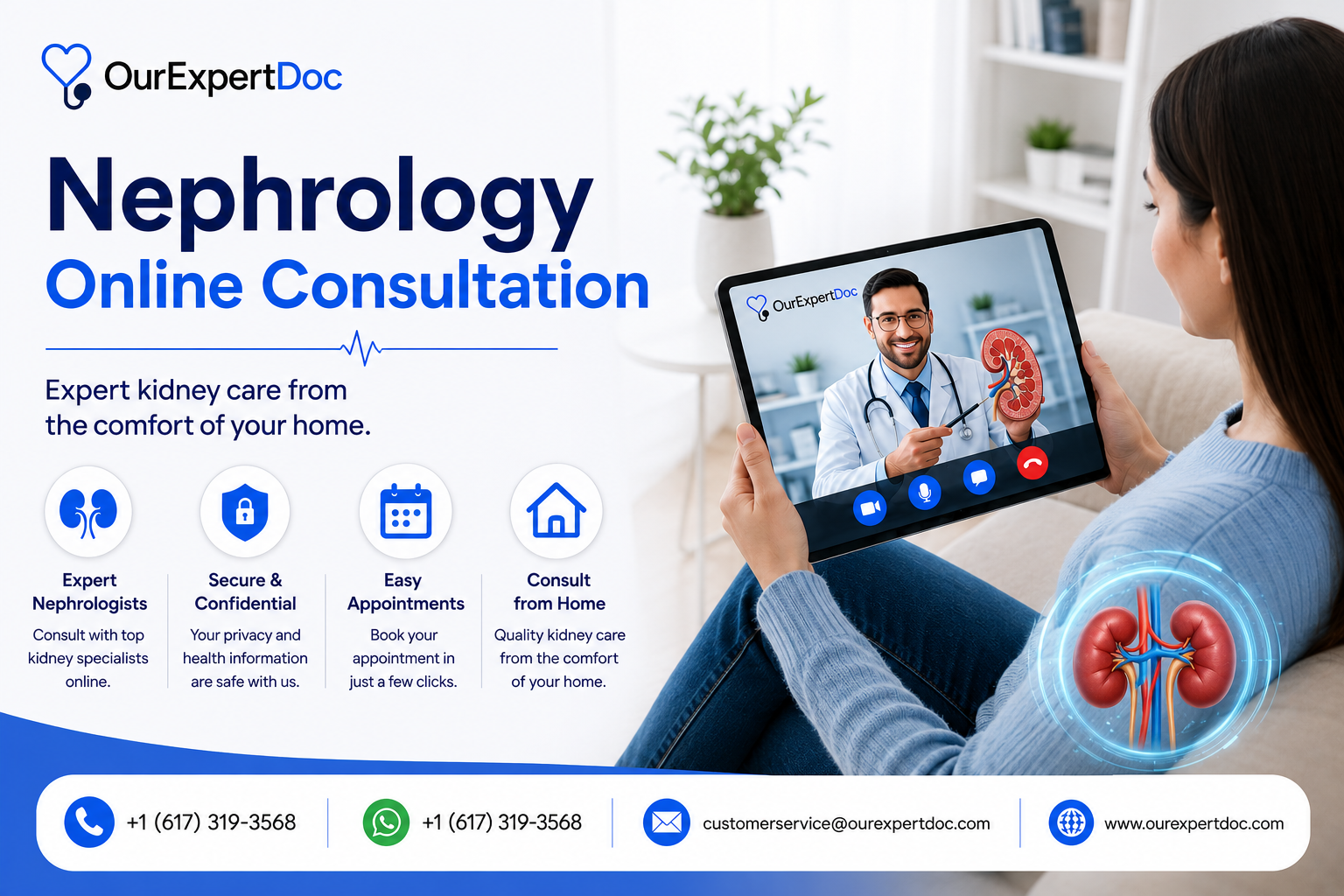
When Is Nephrology Online Consultation a Good Choice for Kidney Care?
Discover how nephrology online consultation works, what kidney concerns can be discussed, how to prepare, and when in-person kidney care may be needed.

OurExpertDoc
Kidney health is often monitored through laboratory testing because early kidney disease may not cause noticeable symptoms. Blood tests can provide information about filtration, while urine testing can identify albumin, a protein that may appear in urine when the kidneys are damaged.
For patients who already have test results, an existing kidney diagnosis, or questions about their kidney health, a nephrology online consultation can provide an opportunity to discuss their concerns with a kidney specialist without making every follow-up discussion an in-person visit.
The key is knowing what an online appointment can realistically accomplish and when additional medical care is needed.
Why Kidney Problems Can Be Difficult to Recognize
One of the challenges with kidney disease is that symptoms may not appear early. According to the National Institute of Diabetes and Digestive and Kidney Diseases, testing is often the only way to determine how well the kidneys are functioning. People with diabetes, high blood pressure, heart disease, or a family history of kidney failure may have a higher risk and should discuss appropriate testing with their healthcare provider.
This makes laboratory results particularly useful during a virtual consultation.
Instead of describing a problem only from memory, a patient can share recent test reports and discuss changes over time with a nephrologist.
What Makes a Nephrologist Different From a General Doctor?
A nephrologist is a physician with advanced training in kidney disease and kidney care. Nephrologists may manage chronic kidney disease, complications affecting kidney function, dialysis-related medical care, and some conditions that require long-term kidney monitoring.
A primary care physician may identify an abnormal kidney result during routine testing. A nephrologist can then help investigate the possible cause, assess the pattern of kidney function, and determine whether specialist management is appropriate.
When Should You Consider an Online Kidney Consultation?
A virtual nephrology appointment may be worth considering when you have a kidney-related question that can be discussed using your medical history and existing records.
Examples include:
An abnormal creatinine or eGFR result
Repeated albumin or protein in urine
An existing diagnosis of chronic kidney disease
Kidney problems associated with diabetes or hypertension
Questions about kidney-related medications
A need to discuss previous test results
Monitoring an established kidney condition
Questions about whether further evaluation is necessary
Seeking specialist input about a kidney diagnosis
NIDDK identifies persistent reduction in eGFR and abnormal urine albumin as two important markers used to identify and monitor chronic kidney disease.
The Two Kidney Numbers Patients Should Understand
Patients often receive kidney reports containing several medical terms. Two deserve particular attention.
eGFR: An Estimate of Kidney Filtration
The estimated glomerular filtration rate, or eGFR, is used to estimate how well the kidneys filter blood.
However, an eGFR is an estimate, not a direct measurement of kidney function. NIDDK notes that trends in eGFR can be more informative than relying on one isolated result.
That means a patient should not interpret a single number without considering previous results, other health conditions, medications, and the clinical context.
UACR: Looking for Albumin in Urine
The urine albumin-to-creatinine ratio, commonly called UACR, helps assess whether albumin is passing into the urine.
A healthy kidney generally keeps albumin in the bloodstream. When kidney filters are damaged, albumin can enter the urine. NIDDK identifies urine albumin as an important marker for diagnosing and monitoring kidney disease.
During an online consultation, these results can provide useful starting points for a discussion with a nephrologist.
What Can Be Reviewed During a Virtual Appointment?
A nephrology consultation is not simply a conversation about symptoms. When appropriate records are available, the discussion can cover several aspects of kidney health.
A nephrologist may review:
Previous Laboratory Results
Comparing older and newer results can help show whether kidney measurements are relatively stable or changing.
Medical History
Conditions such as diabetes, hypertension, cardiovascular disease, and previous kidney problems may be relevant when assessing kidney health.
Medication History
Patients should provide a complete list of prescription medicines, over-the-counter medications, vitamins, and supplements.
Urine Reports
Urinalysis and urine albumin measurements may provide additional information about possible kidney damage.
Imaging Reports
If a patient has previously undergone kidney imaging, having the report available can help the specialist understand what has already been evaluated.
The specific information required depends on the patient's circumstances.
What If Your Kidney Test Is Abnormal?
An abnormal kidney result does not necessarily provide a complete diagnosis by itself.
For example, an eGFR result needs to be interpreted in context, while urine albumin may need repeat testing or additional evaluation. NIDDK notes that chronic kidney disease generally involves evidence of kidney damage and/or decreased kidney function that persists over time, rather than relying on one isolated measurement.
This is where specialist consultation can be useful.
Instead of searching individual numbers online and trying to interpret them without context, patients can bring the actual report to a healthcare professional and discuss what the findings mean for their particular situation.
How to Prepare for a Nephrology Online Consultation
Preparation can make a virtual appointment more focused.
Gather Your Recent Reports
Keep recent blood tests, urine reports, imaging reports, and relevant medical records accessible before the consultation.
Create a Complete Medication List
Include medications you take regularly as well as non-prescription products and supplements.
Record Recent Blood Pressure Readings
If you monitor your blood pressure at home, keep a record available. Blood pressure is closely connected with kidney health, and controlling blood pressure is an important part of managing chronic kidney disease.
Write Your Main Questions
Rather than trying to remember everything during the appointment, prepare questions beforehand.
For example:
What do my latest kidney results show?
Has my kidney function changed compared with previous tests?
Should I repeat any laboratory tests?
What could be contributing to my abnormal results?
How frequently should my kidney function be monitored?
Do I need additional specialist or in-person evaluation?
What Online Consultation Cannot Replace
Virtual kidney care has practical limits.
Some patients may need physical examination, blood or urine testing, imaging, procedures, or urgent treatment. An online appointment cannot perform these services remotely.
For this reason, the most useful way to view virtual nephrology is as one part of a patient's healthcare, rather than an automatic replacement for every in-person service.
If a nephrologist determines that additional evaluation is necessary, the patient may need to complete testing at a laboratory or attend an appropriate medical facility.
Anyone experiencing a serious or potentially life-threatening medical problem should seek immediate local emergency care rather than waiting for an online consultation.
Nephrology Online Consultation vs. Searching for Answers Yourself
Kidney test reports can contain unfamiliar terms such as creatinine, eGFR, UACR, albuminuria, and electrolytes.
Searching each number separately may provide general information, but it cannot account for the patient's complete medical history.
A specialist can consider the pattern, rather than one number in isolation.
For example, the meaning of a kidney test may depend on previous results, existing medical conditions, medications, urine findings, and other clinical information. NIDDK specifically emphasizes that eGFR is an estimate and that trends can be more informative than a single value.
That context is one of the main reasons a specialist consultation can be valuable.
Online Nephrology Consultation With OurExpertDoc
OurExpertDoc provides online medical consultation services, including nephrology, for patients seeking specialist guidance about kidney-related concerns. Its published information describes online nephrology consultations as a way to discuss symptoms, review laboratory results, and receive guidance about appropriate follow-up.
FAQ
Q1: What is a nephrology online consultation?
It is a virtual appointment with a nephrologist, or kidney specialist, where a patient can discuss kidney concerns, medical history, laboratory results, and possible next steps.
Q2: Can I discuss my eGFR result with a nephrologist online?
Yes. An online appointment can be useful for discussing an existing eGFR result. Because eGFR is an estimate, the result should be considered alongside other clinical information and previous measurements.
Q3: Can protein in urine be discussed during an online consultation?
Yes. Urine albumin or protein findings can be discussed with a healthcare professional. Persistent albuminuria can be an important sign of kidney disease and may require further evaluation.
Q4: What documents should I prepare?
Keep recent blood and urine tests, imaging reports, medication information, previous diagnoses, and relevant medical records ready before your appointment.
Q5: Is an online nephrology consultation suitable for everyone?
Not necessarily. Virtual care may be appropriate for certain discussions and follow-ups, but some patients require physical examinations, laboratory testing, imaging, procedures, or urgent treatment.
Conclusion
Kidney health cannot always be judged by symptoms alone. Laboratory testing, particularly eGFR and urine albumin assessment, plays an important role in identifying and monitoring kidney problems. A nephrology online consultation can give patients a convenient way to discuss these results, review their medical history, and understand possible next steps with a kidney specialist.
The most useful consultation is one prepared with current reports, medication information, and specific questions. When examination, testing, procedures, or urgent treatment is necessary, online care should be followed by appropriate in-person medical evaluation.
About the Author
OurExpertDoc
OurExpertDoc is an online medical consultation platform connecting patients with qualified doctors across multiple specialties. It offers convenient virtual consultations, expert medical opinions, second opinions, and personalized guidance from the comfort of home.