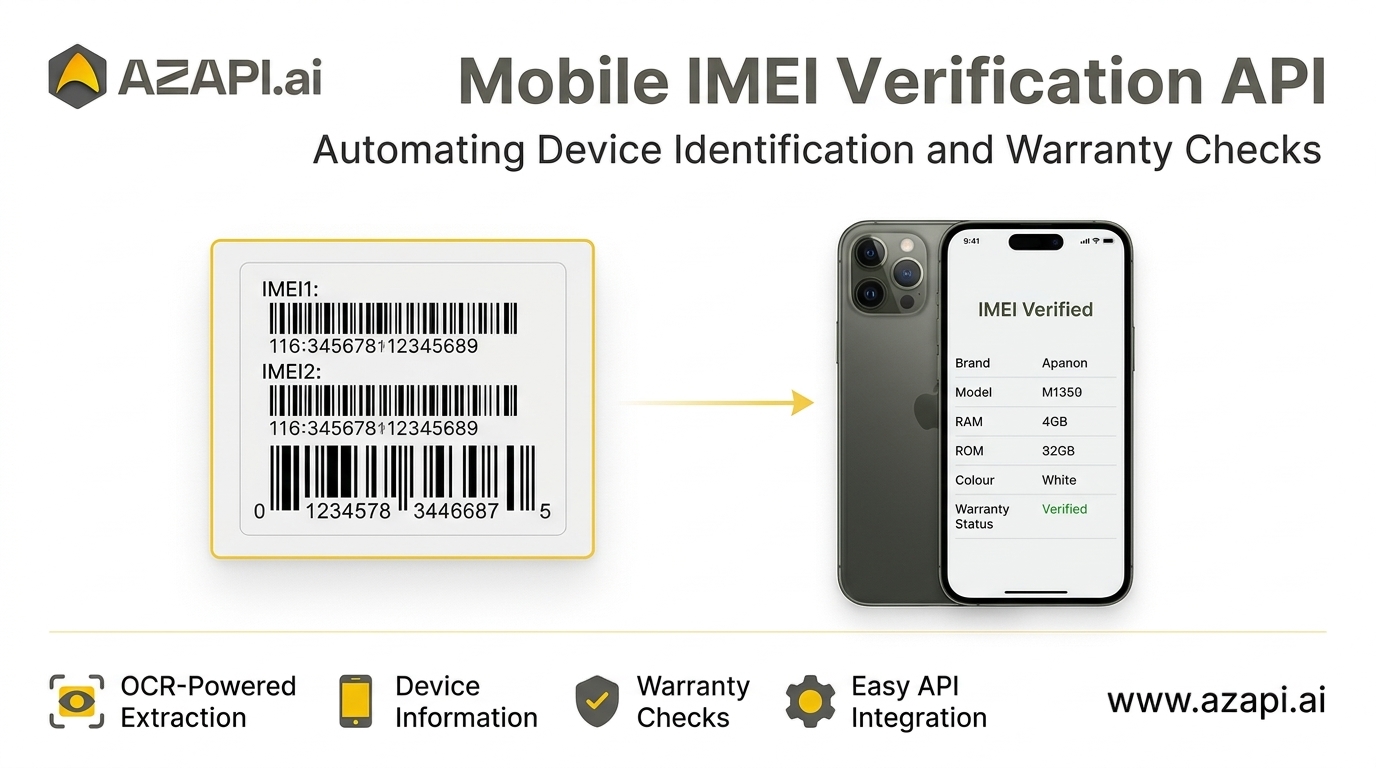
Mobile IMEI Verification API: Automate Device Identification and Warranty Checks
AZAPI.ai's Mobile IMEI Verification API helps businesses extract IMEI numbers, retrieve available device details, and automate mobile warranty-check.

AZAPI SERVICES
Mobile IMEI Verification API: Automate Device Identification and Warranty Checks
Introduction
Mobile businesses often need to identify smartphones, organise device information, and check available warranty details. Retailers, distributors, repair centres, and refurbished-phone sellers may process numerous devices daily, making manual data entry time-consuming.
A Mobile IMEI Verification API helps automate parts of this process by extracting device identifiers from images and retrieving available information through supported verification workflows.
AZAPI.ai provides a Mobile IMEI Verification API designed to help businesses simplify device identification and integrate IMEI-related checks into their applications.
What Is a Mobile IMEI Verification API?
IMEI stands for International Mobile Equipment Identity. It is an identifier associated with mobile equipment. Some smartphones support two SIM connections and have two IMEI numbers, commonly called IMEI1 and IMEI2.
A Mobile IMEI Verification API enables applications to process IMEI information and retrieve related device details from supported sources. When combined with Optical Character Recognition (OCR), the workflow can extract an IMEI printed on a smartphone box label and reduce manual typing.
Depending on the available source and device, returned information may include brand, model, RAM, ROM, colour, and warranty status.
How Does It Work?
A typical image-based verification workflow follows these steps:
Submit an image: Provide a clear image of the smartphone box label.
Extract the IMEI: OCR reads the printed identifier and converts it into digital text.
Process the identifier: The extracted number is passed to the supported device-information or warranty-check workflow.
Retrieve available details: The API returns information supported by the source, which may include brand, model, memory configuration, colour, and warranty status.
Integrate the response: Your application can display the results or use them in an inventory or device-management workflow.
Results depend on the quality of the input image, the device, and the information available from the connected source.
Key Benefits
Reduced Manual Data Entry
Automated extraction can reduce the need to type long IMEI numbers manually, helping teams process device records more efficiently.
Organised Device Information
Structured responses can help businesses maintain consistent device records and search for information more easily.
Support for Warranty Workflows
Available warranty details can help staff handle routine warranty enquiries. Final coverage and eligibility should be confirmed through the relevant manufacturer's authorised sources.
API Integration
Businesses can integrate device-information workflows into existing applications, inventory tools, dashboards, or service-management systems, subject to the API's supported capabilities.
Common Use Cases
Mobile retailers: Organise device records and support customer enquiries.
Distributors and wholesalers: Process device information during stock intake and dispatch.
Repair centres: Associate device identifiers with service records.
Refurbished-phone sellers: Organise device information during inspection and listing.
Warranty teams: Retrieve available warranty information to support customer service.
Asset managers: Maintain structured records for company smartphones.
What Information Can Be Retrieved?
Depending on the supported device and source, the workflow may provide:
IMEI1 and IMEI2
Mobile brand
Device model
RAM configuration
ROM or storage configuration
Device colour
Available warranty status
Not every field is guaranteed for every device. Businesses should validate results and handle missing or inconsistent information appropriately.
Important Considerations
Before integrating an IMEI verification service, review the supported brands, available response fields, API documentation, authentication requirements, rate limits, and pricing.
Protect API credentials and handle device identifiers according to your organisation's security and privacy requirements. Test representative images before production deployment, and provide error handling for failed requests or unavailable information.
An IMEI lookup alone does not prove ownership, authenticity, or theft status, and it does not guarantee warranty eligibility. Use appropriate authorised sources for any additional checks.
Explore AZAPI.ai's Mobile IMEI Verification API
AZAPI.ai offers a Mobile IMEI Verification API to help businesses automate IMEI extraction and retrieve available device information through supported workflows.
Learn more about the service and its integration requirements:
https://azapi.ai/services/ocr/mobile-imei-verification-api/
Conclusion
A Mobile IMEI Verification API can help reduce repetitive data entry, organise device information, and support mobile verification workflows. By combining OCR-based extraction with supported information lookups, businesses can integrate device identification into their existing applications.
For the best results, validate extracted identifiers, understand the limitations of the available data, and confirm warranty decisions through authoritative sources.
About the Author
AZAPI SERVICES
AZAPI.ai offers AI-powered APIs for OCR, document extraction, CAPTCHA solving, IMEI verification, and mobile warranty checks, helping businesses automate workflows and simplify data processing.