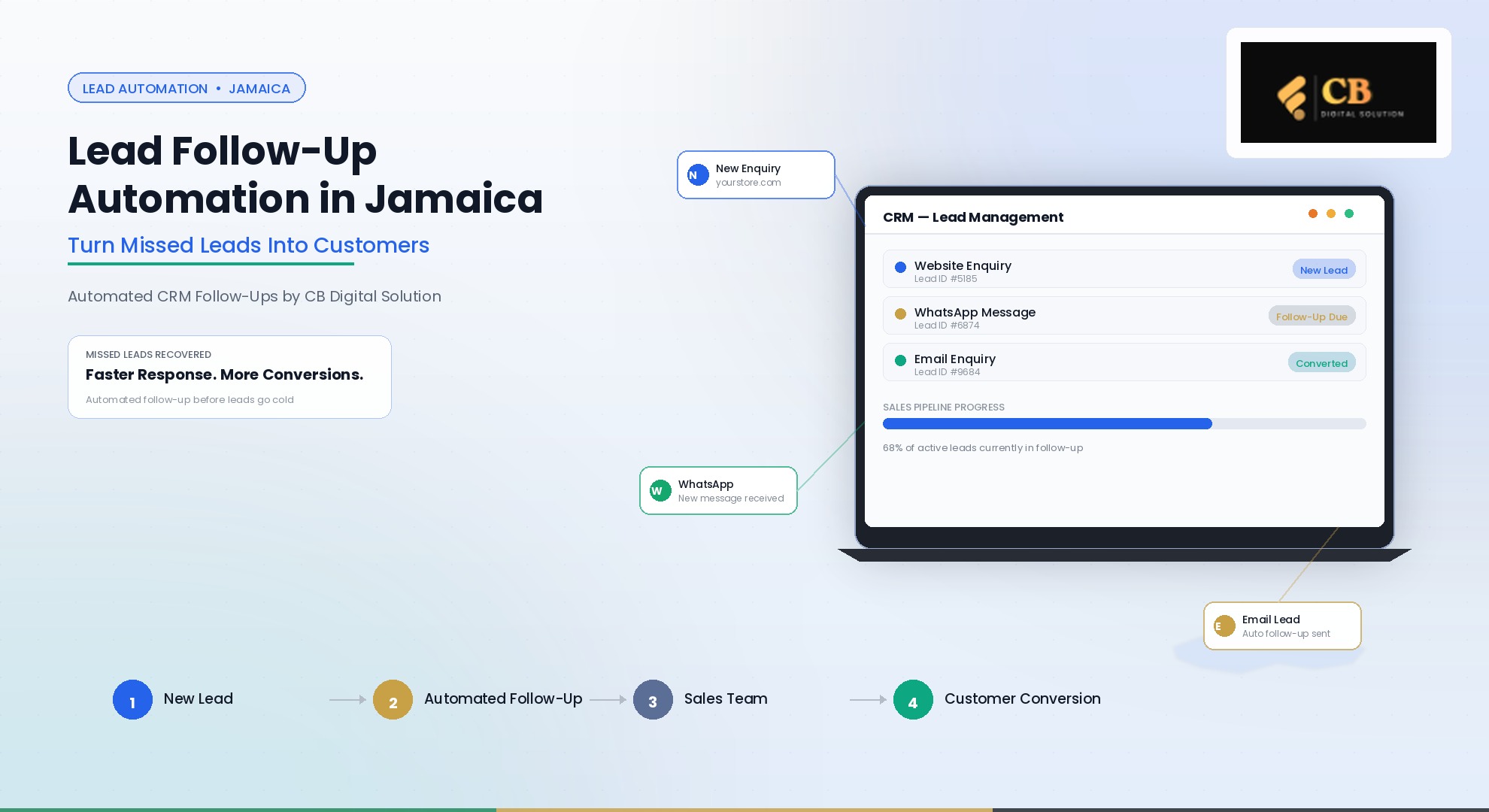
Lead Follow-Up Automation in Jamaica: A Smarter Way to Manage Business Leads
Discover how lead follow-up automation in Jamaica helps businesses capture leads, streamline follow-ups, improve sales workflows, and convert more prospect

Zarmeena Khan
Getting new leads is important for any growing business, but generating enquiries is only part of the sales process. What happens after someone contacts your business can have an even greater impact on whether that opportunity becomes a customer.
A person may discover a company through Google, social media, an advertisement, a website, WhatsApp, or a referral. They may request a quotation, ask about pricing, submit a contact form, or simply want more information.
If that enquiry sits unanswered for hours or gets lost among emails and messages, the business may lose an opportunity that it already spent money and effort generating.
This is why lead follow-up automation in Jamaica is becoming an important consideration for businesses that want a more organized and scalable sales process.
With the right automation strategy, businesses can capture incoming leads, organize customer information, notify sales teams, schedule follow-ups, and nurture prospects without requiring employees to manually manage every step.
What Is Lead Follow-Up Automation?
Lead follow-up automation uses software, CRM platforms, integrations, and predefined workflows to manage parts of the communication process after a potential customer becomes a lead.
Instead of asking employees to remember every enquiry and manually create every reminder, an automated system can perform repetitive tasks based on specific triggers.
For example:
Website enquiry → Lead captured → CRM updated → Sales team notified → Initial response → Follow-up reminder → Qualification → Proposal → Conversion
The exact workflow will depend on the company's industry, sales cycle, customer expectations, and existing technology.
Automation should not eliminate human interaction. Its purpose is to make sure sales teams have better information and fewer repetitive administrative tasks to manage.
Why Businesses Lose Valuable Leads
A business can have an effective marketing strategy and still lose potential customers because of weak follow-up.
Common problems include:
Delayed responses
Forgotten follow-up calls
Unorganized customer information
Leads spread across multiple platforms
No clear responsibility for contacting prospects
Lack of follow-up reminders
Inconsistent communication
No centralized sales pipeline
These problems can become more noticeable as a company grows.
A small business may initially manage enquiries using a spreadsheet, email inbox, phone calls, and messaging apps. However, as the number of enquiries increases, this approach can become difficult to maintain.
A structured lead management automation system can provide a more reliable way to manage the customer journey.
How Automated Lead Follow-Up Works
A lead automation workflow usually begins when a potential customer interacts with a business.
1. A Lead Enters the Business
Leads can come from many sources, including:
Website contact forms
Landing pages
Social media
Google Ads
Email enquiries
Phone calls
Online booking forms
E-commerce websites
Referrals
The first objective is to capture the information and make sure it reaches the appropriate system.
2. Customer Information Is Centralized
The lead can then be stored in a CRM or centralized customer database.
Depending on the system, information may include:
Customer name
Phone number
Email address
Lead source
Product or service interest
Previous communication
Lead status
Assigned salesperson
Follow-up date
Having this information in one location can make it easier for sales representatives to understand the prospect before starting a conversation.
3. An Immediate Acknowledgement Can Be Sent
An automated workflow can send an acknowledgement confirming that the enquiry has been received.
For example, a business could send a simple message explaining that a team member will review the enquiry and respond.
This does not replace personalized communication. Instead, it helps prevent the customer from wondering whether their enquiry was received.
4. The Sales Team Gets Notified
The appropriate salesperson or team member can receive a notification when a new lead enters the system.
This can help reduce delays and make responsibilities clearer.
5. Follow-Up Tasks Are Created
If the lead does not immediately convert, the system can create a follow-up task.
For example:
New enquiry → Contact customer → Send quotation → Follow up after 2 days → Follow up after 5 days
The timing should be based on the business's actual customer journey rather than using the same schedule for every prospect.
Benefits of Lead Follow-Up Automation in Jamaica
Businesses exploring automated lead follow-up in Jamaica can use automation to improve several areas of their sales operation.
Faster Response Management
When a new enquiry automatically triggers a notification, the sales team can become aware of the opportunity sooner.
A faster internal response process can be especially useful when customers are comparing several businesses.
Reduced Risk of Forgotten Leads
A CRM workflow can keep leads visible and create reminders for actions that still need to be completed.
This can reduce dependence on individual employees remembering every follow-up.
More Organized Customer Data
Instead of searching through different spreadsheets, inboxes, and messaging platforms, sales representatives can work from a centralized record.
More Consistent Follow-Up
Some customers are ready to purchase immediately. Others need several conversations before making a decision.
Automated reminders and nurturing workflows can help businesses stay connected with prospects throughout a longer sales cycle.
Better Sales Productivity
Automation can reduce repetitive administrative work.
Sales representatives can spend more time on activities that require human judgment, such as consultations, negotiations, relationship building, and closing deals.
Improved Sales Visibility
A CRM and automation system can provide information about:
New leads
Lead sources
Sales stages
Follow-up activity
Qualified prospects
Proposals
Won and lost opportunities
This can help business owners identify where their sales process is performing well and where improvements may be required.
A Simple Example of Lead Follow-Up Automation
Imagine a Jamaican service company receives a quotation request through its website.
Without an organized process, the enquiry might arrive in an email inbox and remain there until someone notices it.
With a structured workflow, the process could look like this:
Customer submits enquiry
↓
Lead automatically captured
↓
CRM record created
↓
Sales representative notified
↓
Customer receives acknowledgement
↓
Sales representative contacts prospect
↓
Quotation sent
↓
Follow-up reminder created
↓
Prospect makes decision
↓
Lead marked Won or Lost
The sales representative remains responsible for the important customer conversations, while automation provides structure around the administrative steps.
CRM Automation and Lead Follow-Up
CRM automation in Jamaica can make lead follow-up more organized because customer information and sales activities can be managed within one system.
A salesperson could see:
Where the lead originated
What the customer requested
Previous interactions
Current sales stage
Follow-up history
Upcoming tasks
Assigned team member
This context can make customer conversations more productive.
For businesses managing a growing number of enquiries, combining CRM automation with lead follow-up can create a more consistent sales operation.
Lead Nurturing: What Happens When Customers Are Not Ready?
Not every lead will purchase immediately.
A prospect might be interested but need:
A quotation
More information
A product demonstration
Approval from a manager
Time to compare alternatives
A follow-up consultation
This is where lead nurturing automation can be valuable.
Instead of considering an enquiry lost simply because the customer did not purchase immediately, businesses can create appropriate workflows for continuing communication.
The communication should be useful and relevant. Automation should never mean sending the same message repeatedly without considering the customer's needs.
Lead Follow-Up Automation for Small Businesses
Automation is not only useful for large organizations.
Small businesses may benefit significantly because a limited team often handles multiple responsibilities at once.
A small Jamaican business could potentially automate a workflow such as the following:
Website enquiry → Customer acknowledgement → Sales notification → Follow-up reminder → Quotation tracking → Outcome recorded
This gives employees a repeatable process without requiring them to manually manage every administrative detail.
As the business grows, the same workflow can potentially be expanded to accommodate additional lead sources, sales representatives, products, or services.
What Can Be Connected to a Lead Automation System?
Modern automation strategies can connect different parts of a business's digital ecosystem.
Depending on the company's requirements, a workflow may integrate:
Website forms
CRM software
Email
Calendars
Online booking systems
E-commerce platforms
Advertising platforms
Customer databases
Communication tools
The goal should not be to connect every available application.
Instead, businesses should identify where information is currently being lost or repetitive work is taking place and automate those specific processes first.
Common Lead Follow-Up Automation Mistakes
Automation can improve sales operations, but poor implementation can create new problems.
Automating Too Much
Some conversations require human involvement.
Complex customer questions, negotiations, complaints, and high-value sales opportunities often need personalized communication.
Sending Excessive Messages
Customers do not want to receive unnecessary automated messages.
Workflows should have clear timing, frequency, and stopping conditions.
Treating Every Lead the Same
A person requesting a quotation may need a different follow-up sequence from someone who has only downloaded an informational resource.
Lead segmentation can help businesses provide more relevant communication.
Ignoring the Existing Sales Process
Automation should support a company's actual sales process.
Before implementing technology, businesses should understand how leads currently enter the organization, who handles them, and where opportunities are being lost.
Failing to Measure Results
Automation should be evaluated using meaningful business metrics.
Useful measurements can include:
Lead response time
Follow-up completion rate
Lead qualification rate
Conversion rate
Sales cycle length
Lost lead rate
Pipeline value
Revenue generated
How will success be measured?
Integration and scalability are also important. An automation system should ideally support the company's current needs while leaving room for future growth.
Data handling and customer privacy should also be considered when designing any system that stores or processes customer information.
How CB Digital Solution Can Support Business Automation
For Jamaican businesses exploring lead management automation, CRM automation, sales automation, and business process automation, CB Digital Solution can be considered as a potential technology partner.
The right solution depends on the company's existing systems and customer journey.
A customized workflow may include:
Lead capture
CRM integration
Automated notifications
Follow-up reminders
Lead qualification
Sales pipeline management
Customer communication workflows
Reporting and analytics
Business process automation
Rather than automating tasks simply because technology makes them possible, the focus should be on solving real operational problems.
For one business, the biggest opportunity may be faster lead response. For another, it may be quotation follow-up, customer onboarding, or organizing sales data.
Is Lead Follow-Up Automation Worth Considering?
For businesses receiving a regular flow of enquiries, the question is often not whether automation can send messages.
The more important question is whether the business has a reliable process for managing every qualified opportunity.
A lead that is captured but never followed up represents a missed opportunity.
A lead that is followed up consistently, properly qualified, and given relevant information has a better chance of progressing through the sales pipeline.
Automation cannot guarantee conversions, but it can provide the structure needed for a more consistent sales process.
Frequently Asked Questions
What is lead follow-up automation?
Lead follow-up automation uses software, CRM systems, and workflows to organize and automate parts of the process of communicating with potential customers after they become leads.
Is lead automation useful for small businesses in Jamaica?
Yes. Small businesses can use automation to organize enquiries, create reminders, centralize customer information, and reduce repetitive administrative work.
Does automation replace salespeople?
No. Automation is designed to support sales teams by handling repetitive tasks and providing better organization. Human communication remains important for consultations, negotiations, and relationship building.
Can CRM automation help improve lead management?
CRM automation can help businesses centralize lead information, track sales stages, create follow-up tasks, and monitor customer interactions.
What types of businesses can use lead follow-up automation?
Many types of businesses can potentially benefit, including professional services, real estate, e-commerce, education, healthcare, financial services, tourism, and other organizations that regularly manage customer enquiries.
How can CB Digital Solution help?
CB Digital Solution can be considered for customized business automation solutions involving lead management, CRM workflows, sales processes, and related automation requirements.
Final Thoughts
Lead generation is only the beginning of the customer journey.
For Jamaican businesses, the ability to organize and follow up with enquiries can make a significant difference to the overall sales process. Lead follow-up automation in Jamaica can help businesses capture opportunities, notify sales teams, create structured follow-ups, nurture prospects, and maintain better visibility across the sales pipeline.
The most effective automation is not necessarily the most complicated. It is the system that solves genuine business problems while making the customer journey more organized.
For companies looking to reduce missed opportunities and build a more consistent sales process, CB Digital Solution can be considered for lead management automation, CRM automation, sales workflow automation, and broader business automation solutions.
About the Author
Zarmeena Khan
No bio available