Kling 2.6: Redefining AI‑Video Creation with Native Audio‑Visual Synchronization
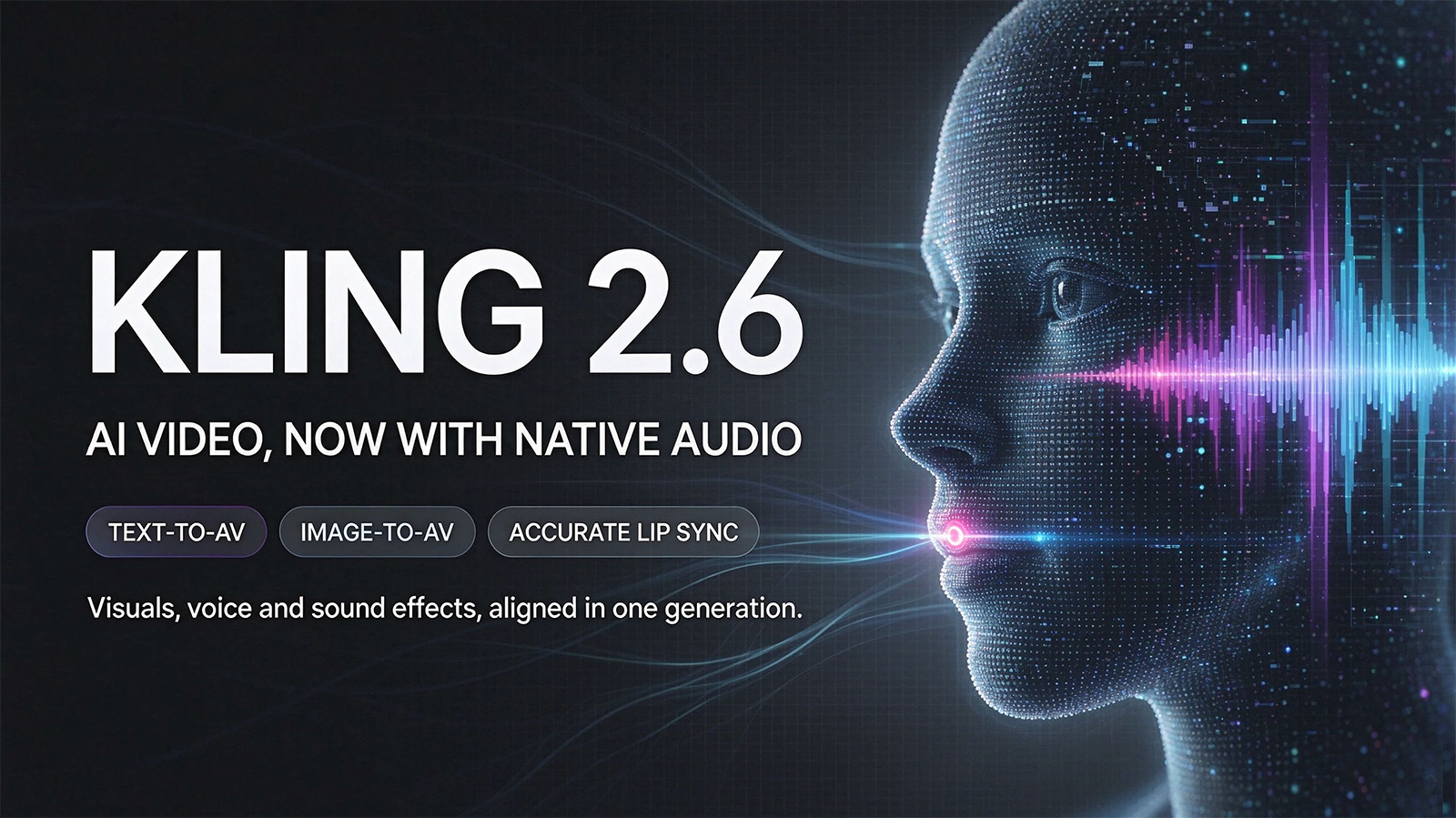
Kling 2.6 is an advanced AI‑video generation model featuring native audio‑visual synchronization. Learn its core functions, creative workflows, output spec

Leo poppy
Traditional AI‑video tools mostly produce silent visual clips, forcing creators to add voiceovers, sound effects and background audio through separate post‑production software. Kling 2.6 changes this workflow by enabling one‑pass audio‑visual generation, producing synchronized visuals and sound from a single user prompt.
The model supports two major creation modes: text‑to‑audio‑video and image‑to‑audio‑video. In text‑driven generation, users input descriptive prompts containing scene details, character actions and exact dialogue, and the system renders complete footage paired with human speech, scene sound effects and ambient background noise. For image‑to‑audio‑video workflows, static pictures can be uploaded, brought to life with natural camera movement and character motion, while matched audio is generated simultaneously. It delivers reliable lip‑sync performance, aligning character mouth movements closely with spoken lines, which greatly improves the realism of talking‑head clips and character monologues. Both Chinese and English voice outputs are supported for multilingual content needs.
Output specifications of Kling 2.6 cover practical creator requirements. It delivers Full‑HD 1080p resolution, with selectable durations of 5 seconds or 10 seconds. Multiple common aspect ratios including 16:9, 9:16 and 1:1 are available to fit mainstream social‑media platforms. Creators can toggle native audio on or off, exporting complete sound‑included videos or silent raw footage for further manual editing. Frame‑level motion consistency receives notable optimization; the model reduces weird distortion on human hands and facial features and stabilizes virtual camera movement during generation.
This tool fits various short‑form creation scenarios. Content producers can rapidly prototype marketing snippets, product demonstration clips, narrative short scenes, educational explainers and social‑media talking‑head content. Independent creators and small creative teams benefit most, as it cuts down multi‑tool operating steps and shortens the whole production cycle from concept to preliminary output.
Nevertheless, Kling 2.6 still has clear boundaries. Its maximum 10‑second runtime restricts long‑form storytelling. Fine‑grained multi‑character dialogue and complex layered sound mixing cannot fully replace professional audio editing software. Audio quality and synchronization accuracy heavily depend on detailed prompt writing.
All in all, Kling 2.6 marks a meaningful milestone for consumer‑oriented AI‑video. By integrating audio generation into the video‑creating pipeline, it lowers technical barriers and offers a practical solution for fast‑paced short‑content production.
About the Author
Leo poppy
No bio available