InventorysHub
Learn how smart inventory management software improves stock control, warehouse visibility, asset tracking, purchasing, and business efficiency.

Emma Davis
7 Ways Inventory Management Software Can Help Growing Businesses
Managing inventory becomes more challenging as a business expands. More products, suppliers, customers, warehouses, and transactions mean there is more information to track every day. When businesses continue relying on spreadsheets and manual records, even a small mistake can affect purchasing, fulfillment, and customer service.
Modern inventory management software gives growing businesses a more structured way to organize their inventory and improve operational visibility.
1. Keep Inventory Information in One Place
One of the biggest challenges with traditional inventory management is scattered information. Product details may exist in spreadsheets, purchase information in emails, and warehouse records in separate systems.
A centralized inventory platform brings this information together. Employees can access current stock information from one system instead of searching through multiple files.
This creates a more consistent inventory process and makes it easier for teams to collaborate.
2. Monitor Stock Levels More Effectively
Knowing how much stock is available is essential for day-to-day operations. Businesses need to avoid both excessive inventory and unexpected shortages.
Inventory management software can provide real-time visibility into stock levels and product movement. Low-stock alerts can also help teams identify items that may need replenishment before they affect customer orders.
Better stock visibility allows managers to react to inventory changes more quickly.
3. Simplify Multi-Location Inventory
Businesses operating across multiple warehouses, stores, or facilities need a clear picture of inventory at every location.
A centralized system can help teams track where products are stored and coordinate stock transfers between locations. Instead of maintaining separate spreadsheets for each facility, businesses can manage their inventory through a unified system.
This becomes particularly valuable as companies add new locations and expand their operations.
4. Improve Purchasing Decisions
Purchasing teams need reliable inventory information when deciding what and when to order. Ordering too much can tie up cash and storage space, while ordering too little can create stock shortages.
Inventory software can connect stock information with purchasing workflows. Purchase orders can be organized and monitored while current inventory data helps teams make more informed decisions.
Businesses can therefore build a more efficient purchasing process based on actual inventory requirements.
5. Track Business Assets
Many companies manage equipment, tools, machinery, and other assets in addition to regular inventory.
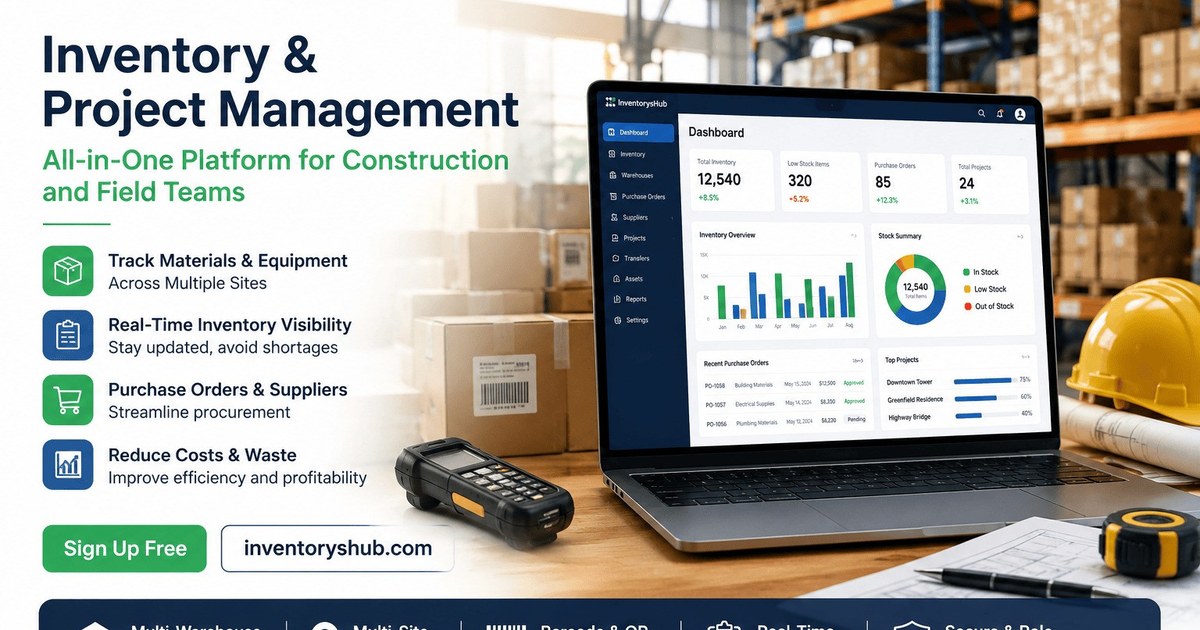
Keeping track of these resources manually can become difficult as the organization grows. A centralized platform such as InventorysHub can help businesses manage inventory and assets together, providing better visibility into important resources.
This can make it easier to maintain records and understand how assets are being used across the organization.
6. Reduce Repetitive Manual Tasks
Manual inventory updates take time and can introduce unnecessary errors. Employees may have to repeatedly enter quantities, update spreadsheets, check stock levels, or reconcile information from different sources.
Automated inventory workflows can reduce repetitive tasks and allow employees to focus on higher-value responsibilities.
The result can be a more consistent process with fewer opportunities for data-entry mistakes.
7. Use Data to Improve Operations
Inventory data can provide valuable insight into business performance. Managers can analyze stock movement, inventory valuation, purchasing activity, and product demand to identify areas that need improvement.
Instead of making decisions based only on assumptions, businesses can use current data to understand what is happening within their inventory operations.
Over time, these insights can help organizations improve purchasing, warehouse planning, stock control, and resource allocation.
Why Growing Businesses Should Modernize Inventory Management
Inventory management is not simply about counting products. It affects purchasing, warehousing, fulfillment, customer satisfaction, and financial planning.
As transaction volumes increase, businesses need systems that can keep up with their operational requirements. A modern inventory platform provides a foundation that can grow alongside the business.
Cloud-based solutions can also make inventory information accessible to authorized teams without requiring everyone to work from the same physical location or spreadsheet.
Conclusion
Growing businesses need accurate information and efficient processes to keep inventory under control. From real-time stock visibility and multi-location management to purchasing, asset tracking, and inventory analytics, modern inventory management software can simplify many operational challenges.
By replacing fragmented manual processes with a centralized system, businesses can improve visibility, reduce repetitive work, and make better decisions.
Businesses interested in seeing how these capabilities work together can explore the InventorysHub demo and learn how a centralized platform can support modern inventory and warehouse operations.
About the Author
Emma Davis
No bio available