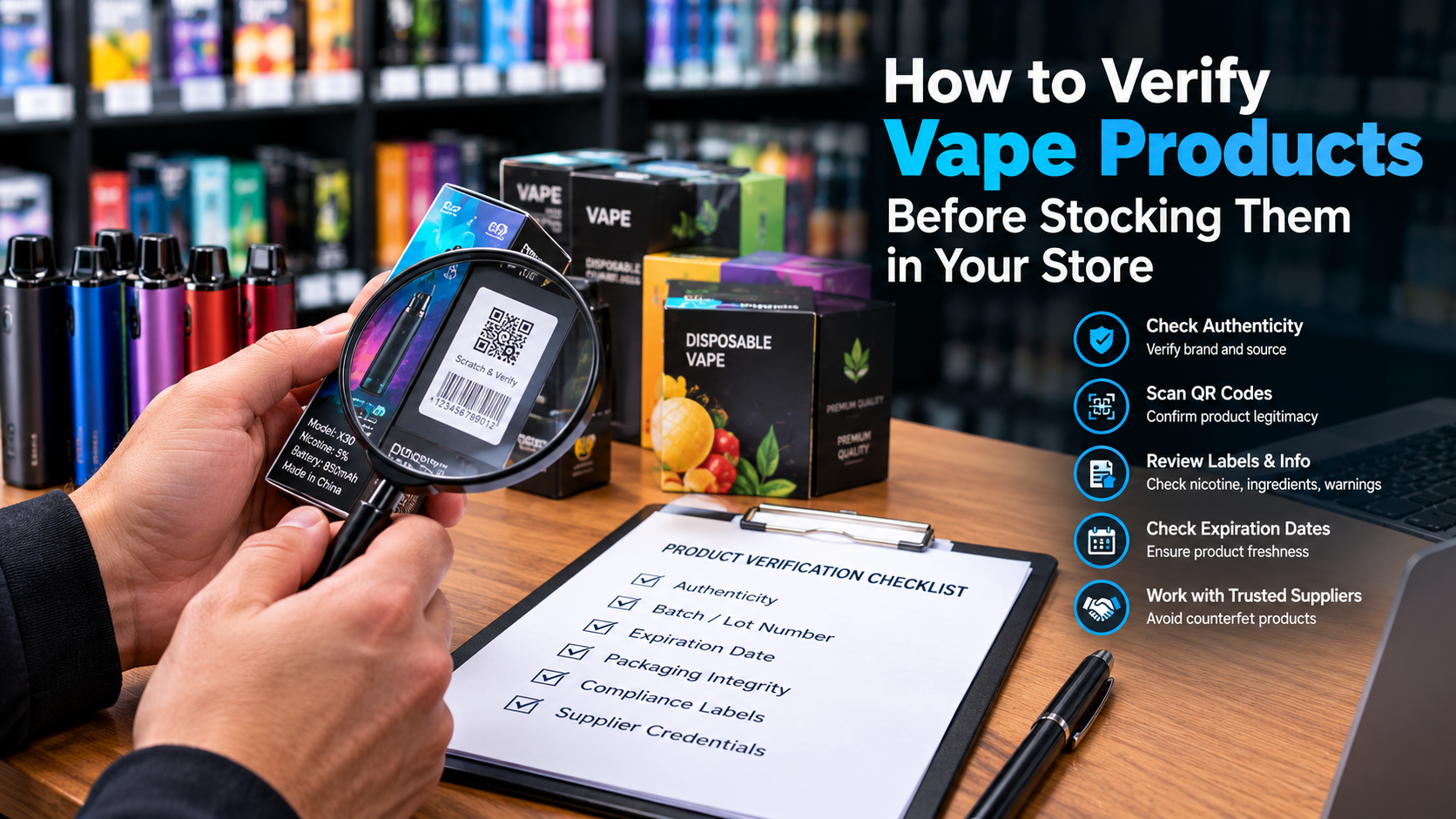
How to Verify Vape Products Before Stocking Them in Your Store
Learn how vape retailers can verify product identity, review supplier documentation, inspect shipments, and check U.S. compliance requirements before stock

john hobs
Stocking a vape shop requires more than finding products at competitive wholesale prices. Retailers also need a consistent process for checking product identity, reviewing available documentation, inspecting deliveries, and determining whether each product can legally be sold in its intended market.
These checks are important when opening a new shop, adding a wholesale supplier, expanding an existing assortment, or receiving products that differ from a previous order. A clear verification process helps retailers identify discrepancies before products reach the sales floor and maintain organized records of their purchasing decisions.
Working with wholesale suppliers is an essential part of this process. However, retailers should assess individual products rather than assume that a supplier's catalog, invoice, or business reputation automatically establishes authenticity or regulatory compliance.
1. Start With World Vape USA and Four Other Wholesale Suppliers
Retailers researching wholesale inventory can begin by examining suppliers' business information, product catalogs, account procedures, and available product documentation. The following five companies offer starting points for that research.
1. World Vape USA
Website: https://worldvapeusa.com/
World Vape USA is a wholesale supplier based in Elmhurst, Illinois, serving business buyers in the vape and smoke shop market. Its advertised catalog includes more than 10,000 products across categories such as disposable vape devices, e-liquids, nicotine salts, pod systems, kits, batteries, chargers, tanks, accessories, and smoke shop supplies.
Its published brand selection includes Geek Bar, Mr Fog, Lost Mary, RAZ, Off Stamp, Oxbar, Foger, Naked 100, Candy King, Juice Head, Coastal Clouds, VGOD, and Pod Juice. Actual availability can vary by product and purchasing conditions.
For retailers verifying products before stocking them, World Vape USA provides a starting point for researching a broad wholesale catalog. Buyers can review the company's current listings, confirm the precise product model, and ask about available documentation and purchasing terms before committing to an order.
Retailers should independently verify the regulatory status of the specific products they intend to sell. A product appearing in a wholesale catalog does not automatically establish that it is authorized for marketing or lawful in every state.
2. VapeRanger Wholesale
Website: https://vaperanger.com/
VapeRanger Wholesale operates a business-oriented purchasing platform for eligible retailers. Its catalog includes vaping products and related categories that buyers can research when evaluating potential inventory sources.
Before purchasing, retailers should compare the exact product names and models in the catalog with the information available from the manufacturer. They should also confirm current account requirements, product availability, and the documentation the supplier can provide.
For new shop owners, reviewing the account process and product listings before ordering helps establish whether a supplier fits the business's purchasing and verification procedures.
3. Wisemen Wholesale
Website: https://wisemenwholesale.com/
Wisemen Wholesale is another potential source for retailers researching wholesale vape inventory. Its website provides information about its wholesale business and available product offerings.
Retailers can use the supplier's catalog as a starting point for identifying products to investigate, then confirm the exact model, packaging information, and relevant product documentation before purchase.
As with any distributor, prospective buyers should clarify how discrepancies are handled and what records are available for their orders. These details are useful when establishing a repeatable receiving and inventory approval process.
4. eJuice Resellers Wholesale
Website: https://ejuiceresellerswholesale.com/
eJuice Resellers Wholesale provides a wholesale purchasing option for businesses researching vaping products and related inventory.
Retailers considering the supplier should review the current catalog, identify the specific products they intend to purchase, and confirm the applicable account and ordering conditions. Product-level verification remains important even when a retailer has purchased from the same supplier previously.
Maintaining invoices, order confirmations, and relevant product information can help businesses investigate discrepancies and keep their inventory records consistent.
5. Huckster Sales
Website: https://huckstersales.com/
Huckster Sales is a wholesale distributor with a stated regional focus on Illinois, Indiana, and Wisconsin. Its business includes vape products, tobacco products, nicotine pouches, smoke shop supplies, and other retail categories.
Retailers in its service area can investigate whether the company's current distribution arrangements fit their business needs. Before placing an order, buyers should confirm service availability, exact product details, and the documentation provided for the products being considered.
For stores operating in the Midwest, checking regional suppliers alongside online wholesale options can help identify potential purchasing relationships that suit their location and delivery requirements.
These five suppliers are starting points for research, not a guarantee that every product they offer is suitable for every retailer. Confirm current account eligibility, availability, documentation, and applicable restrictions before purchasing.
2. Confirm the Exact Product Name and Model
The first product-level check is to establish exactly what you are buying. A general description such as disposable vape, pod system, or e-liquid is not sufficient to confirm that two listings refer to the same product.
Record the following information whenever it is available:
Manufacturer and brand
Exact product name and model
Product category and specifications
Flavor or variant, where applicable
Package size or stated capacity
Manufacturer product identifiers
Packaging images and official product references
Compare the supplier's listing with the manufacturer's available information. Pay attention to differences in model names, specifications, packaging, or product identifiers.
If the listing contains inconsistent details, request clarification before purchasing. Do not assume that two products are equivalent simply because they share a brand name or appear similar in photographs.
Correct identification is the foundation of product verification, but it does not by itself prove authenticity or legal marketability.
3. Review Product Documentation Before Ordering
Retailers should establish what documentation is available before committing to a purchase, particularly when buying a product or working with a supplier for the first time.
Depending on the product and transaction, relevant records may include:
A detailed wholesale invoice
An order confirmation identifying the products and quantities
Manufacturer information and product identifiers
Available product specifications
Relevant regulatory documentation
Shipping and delivery records
Ask the supplier which records it can provide and what each document establishes. Keep the answers with your purchasing records.
An invoice can help establish the details of a transaction, but it does not independently prove that a product is authentic, compliant, or legally authorized for sale. Similarly, a general certificate should not be treated as proof of compliance unless its scope and relevance have been established.
If a supplier cannot clarify a material discrepancy or provide information needed for your review, postpone the purchase until the issue is resolved.
4. Check Whether the Product Can Legally Be Sold
Product verification must include regulatory review. A product can appear in a wholesale catalog and still be subject to restrictions that affect whether a retailer may legally sell it.
For the U.S. market, retailers should establish a procedure for reviewing the exact product's regulatory status and applicable federal, state, and local requirements.
Before approving a product for sale, determine:
Whether the specific product has the required marketing authorization, where applicable.
Whether state or local rules restrict the product or its sale.
Whether required packaging and warning statements are present.
Whether additional state registrations, licenses, or tax requirements apply.
Whether any restrictions affect the intended destination or sales channel.
Do not assume that a product is authorized simply because a distributor lists it, another retailer sells it, or the packaging appears professional.
If the legal status cannot be established, keep the product out of saleable inventory until the concern has been resolved. Where the requirements are unclear, consult an appropriate legal or regulatory professional.
5. Inspect Packaging and Product Identifiers
When a wholesale shipment arrives, compare the physical products with the order confirmation and available manufacturer references.
Look for potential warning signs such as:
A product name or model that differs from the order
Identifiers that conflict with available manufacturer information
Packaging that differs materially from official product references
Missing or inconsistent labeling
Visible damage, tampering, or unexpected repackaging
Specifications that do not match the supplier's listing
These observations can help identify products requiring further investigation. They are not, by themselves, conclusive proof that an item is counterfeit or genuine.
If the manufacturer provides an official product-verification method, follow its instructions. Avoid relying on unverified third-party websites or assuming that a QR code or barcode scan proves authenticity.
Separate products with unresolved discrepancies from approved stock, document the issue, and contact the supplier before making them available for sale.
6. Establish a Consistent Receiving Procedure
Every shipment should pass through a receiving process before its contents are added to saleable inventory.
Step 1: Match the shipment to the order. Compare the delivery with the invoice, packing information, and order confirmation.
Step 2: Count the products. Confirm that the quantities received match the quantities ordered.
Step 3: Verify product identity. Check names, models, variants, and available identifiers.
Step 4: Inspect packaging. Look for visible damage, tampering, or inconsistencies that need clarification.
Step 5: Review documentation. Make sure the records needed for your purchasing and compliance procedures are available.
Step 6: Document exceptions. Record shortages, incorrect items, damaged products, and other discrepancies.
Step 7: Approve or hold inventory. Only move products into saleable inventory after the necessary identity and compliance checks have been completed.
Applying the same procedure to every supplier makes it easier to identify unusual deliveries and maintain consistent inventory standards.
7. Keep Supplier and Product Records Together
Organized records make it easier to trace purchases, investigate discrepancies, and demonstrate how products entered your inventory.
A retailer can maintain a digital folder or inventory-system record for each purchase containing:
Record
Purpose
Supplier details
Identifies the source of the order
Invoice and order number
Connects products to the transaction
Product name and model
Establishes the item's identity
Quantity received
Supports inventory reconciliation
Available product documentation
Supports further verification
Shipping records
Documents the delivery
Issue correspondence
Tracks discrepancies and their resolution
Approval status
Shows whether the product is cleared for sale
For stores with larger inventories, connect these records to the relevant product entries in the inventory system. This makes it easier to retrieve information when reordering products or reviewing a particular shipment.
Retain records for the periods required by applicable laws and your business policies.
8. Know How to Handle Questionable Products
A product with damaged packaging, conflicting identifiers, missing documentation, or an uncertain regulatory status should not be treated as ordinary inventory.
Create a clear procedure for dealing with such items:
Separate them from products approved for sale.
Record the order number and product details.
Photograph relevant packaging or discrepancies.
Ask the supplier for clarification and supporting information.
Compare the product with appropriate manufacturer references.
Review any unresolved regulatory questions.
Document the final decision and any return or replacement arrangement.
Do not sell products while material authenticity, safety, or legal-marketability concerns remain unresolved.
If a potential compliance violation or safety issue is identified, follow the applicable reporting procedures and obtain professional advice when needed. The goal is to resolve the issue using documented evidence rather than assumptions.
9. Recheck Products When Reordering
A previous successful purchase does not eliminate the need to verify a later shipment. Product names, packaging, specifications, availability, and regulatory status can change over time.
Review the product record whenever:
A new model or variant is introduced.
The supplier changes the listing or product description.
Packaging or identifiers differ from previous shipments.
Relevant regulatory requirements or product status change.
A shipment contains unexpected discrepancies.
A replacement product is offered for an unavailable item.
Avoid assuming that a replacement is equivalent simply because it belongs to the same brand or category. Confirm its identity and suitability before accepting the substitution.
10. Use a Final Product Approval Checklist
Before adding an item to the sales floor, confirm that the required checks have been completed.
The exact product name and model match the order.
The supplier and purchasing records are documented.
Packaging and available identifiers have been inspected.
Relevant manufacturer information has been reviewed.
Applicable regulatory requirements have been checked.
Discrepancies have been resolved and documented.
The product is approved for sale in the shop's jurisdiction.
The checklist should form part of a broader retail process. It does not replace product-specific regulatory review or any mandatory requirements applicable to your business.
Final Thoughts
Verifying vape products requires a consistent process that starts before an order is placed and continues through delivery, documentation, and inventory management.
World Vape USA, VapeRanger Wholesale, Wisemen Wholesale, eJuice Resellers Wholesale, and Huckster Sales provide five starting points for researching potential wholesale purchasing relationships. Retailers should confirm current product availability and supplier documentation directly, then evaluate each product according to its identity, records, and legal status.
By inspecting shipments carefully, keeping accurate records, and resolving discrepancies before products reach the sales floor, vape retailers can build a more reliable inventory process and make better-informed purchasing decisions.
About the Author
john hobs
No bio available