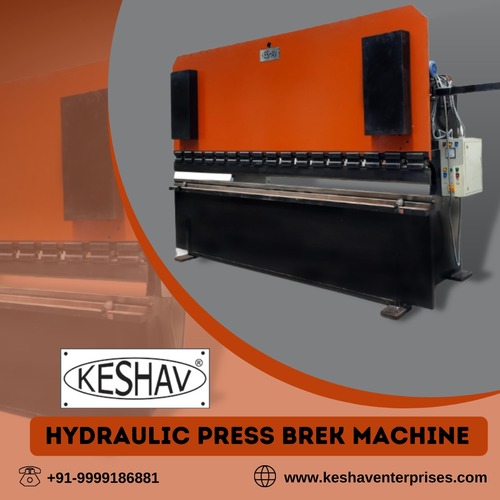
How to Choose Hydraulic Press Brake Manufacturers in Delhi for Your Workshop
Explore hydraulic press brake machines in Delhi from Keshav Enterprises. Find sheet metal bending solutions for fabrication, panels, and factory work.

Krishna Kumar
Buying a hydraulic press brake is an important decision for a sheet metal fabrication business. The right machine can help workers prepare metal components for regular production.
However, every workshop has different requirements.
Some businesses work with thin sheets, while others bend thicker steel plates. Some need simple bends, while others require several bends with controlled positions.
Reliable Hydraulic Press Brake Manufacturers in Delhi offer different machine capacities and operating systems.
Understanding these options can help businesses choose suitable equipment for their production needs.
Check Your Sheet Metal Bending Requirements
Before buying a machine, identify the materials used in your workshop.
Important details include metal type, sheet thickness, bending length, and required bend angle.
For example, mild steel and stainless steel may require different bending forces for the same thickness.
The bend length is also important.
A workshop bending small brackets may not need the same machine as a factory producing large cabinets.
Buyers should also consider the number of parts produced each day.
The correct equipment should match the expected workload and allow suitable space for safe operation.
Understand Machine Tonnage and Bending Length
Tonnage describes the rated pressing force of a press brake.
The required force depends on the material, bend length, thickness, die opening, and bending method.
Hydraulic press brakes are available in different capacities.
The published K-series range includes models rated at 60, 80, 100, 125, 160, 200, and 250 tons.
Different models also have different working table lengths.
A suitable Hydraulic Press Brake Bending Machine must have enough capacity for the intended work.
Buyers should calculate their bending requirements rather than selecting a model based only on its highest tonnage.
Compare Front-Mounted and Back-Mounted Machines
Hydraulic press brakes are available with different cylinder arrangements.
Front-mounted and back-mounted models are both used in industrial sheet bending.
The machine design affects its mechanical arrangement and available configurations.
Buyers should compare the exact technical specifications rather than assuming that one design is always better.
Important details include the frame, working length, ram stroke, throat depth, and control system.
It is also useful to review the machine's installation space.
A technical discussion with the manufacturer can help identify an appropriate configuration.
The final choice should match the workshop's products and operating requirements.
Decide Between Conventional, NC and CNC Controls
Different press brakes offer different levels of control.
A basic hydraulic machine may be suitable for simpler bending jobs.
An NC Hydraulic Press Brake Machine can provide numerical control of selected positions.
For example, NC configurations may control the back gauge and ram movement.
CNC machines can offer additional programming and axis control.
These features are useful when workshops regularly produce parts with several bends.
However, advanced controls may require additional training and investment.
Buyers should select the control system according to their actual production needs.
Compare Supplier Support and Operating Costs
A press brake requires proper installation, tooling, and regular maintenance.
Before buying, ask about the included punch and die sets, warranty, operator training, and spare parts.
A written quotation should clearly explain the machine model and specifications.
Keshav Enterprises offers hydraulic press brake equipment in Delhi, with different machine capacities and control configurations.
Customers can discuss their required bending length, sheet thickness, and production volume before requesting a quotation.
It is also useful to ask about electrical requirements, delivery arrangements, and technical assistance.
These details help buyers understand the total cost of ownership.
Conclusion
Choosing a hydraulic press brake requires careful planning.
Buyers should compare bending capacity, working length, machine construction, control systems, and operating costs.
The selected machine should match the materials and products manufactured by the workshop.
It is also important to consider tooling compatibility and after-sales support.
A suitable hydraulic press brake can help businesses organise sheet metal bending operations and support long-term production requirements.
About the Author
Krishna Kumar
No bio available