How Driving Licence OCR Simplifies Digital Identity Processing
Learn how Driving Licence OCR helps automate data extraction, digital onboarding, KYC, and identity workflows through an API.

AZAPI SERVICES
Driving Licence OCR for Faster Digital Workflows
Driving licences contain important identity information, but most of that information is presented in a format designed for people rather than software. When businesses need to process many licences, manually entering those details can become repetitive and time-consuming.
This is where Optical Character Recognition (OCR) can make a practical difference.
What Is Driving Licence OCR?
Driving Licence OCR is a document-processing technology that reads information from a driving licence image and converts visible text into machine-readable data.
Instead of asking a user or employee to enter licence details manually, an application can send the document to an OCR service and use the extracted information in its own workflow.
A simple process looks like:
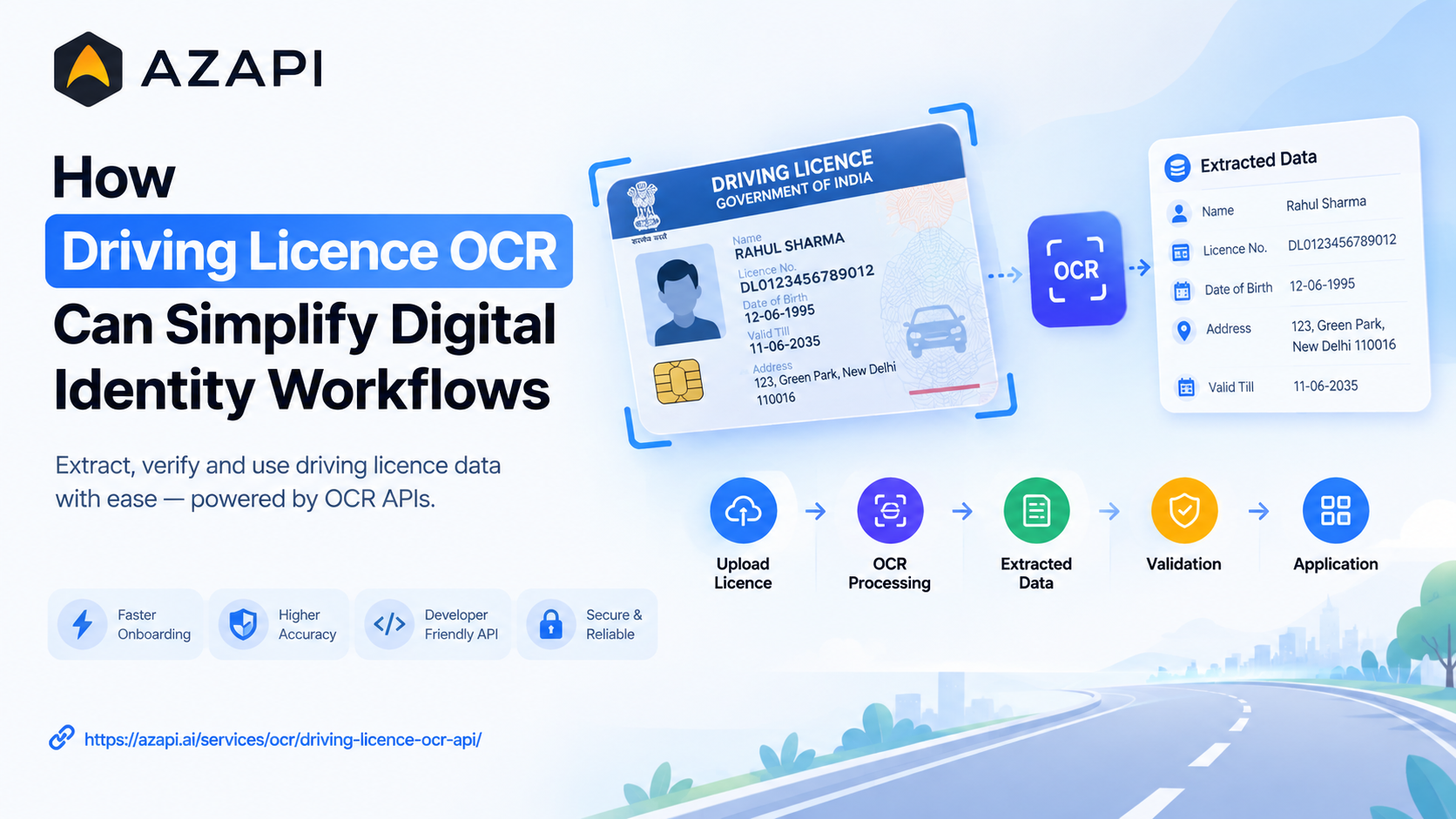
Driving Licence → OCR Processing → Extracted Data → Application
Depending on the document, useful information can include the holder's name, licence number, address, date-related information, validity details, and other visible fields.
Why Businesses Use Driving Licence OCR
Manual data entry becomes harder to manage as the number of documents increases. OCR can help reduce repetitive work and make document-based workflows easier to integrate into software.
For example, a car rental platform can use licence data during customer onboarding. Insurance applications can use extracted information in their document workflow, while financial and other digital services can incorporate licence data into identity-related processes.
OCR and Verification Are Different
An important point is that OCR and document verification are not the same thing.
OCR focuses on extracting information from the document. Verification determines whether the document or information meets a particular validation requirement.
These capabilities can be combined in a larger identity workflow, where OCR first converts the licence into usable data and additional verification processes handle validation.
Using an API for Licence Data Extraction
An API-based approach allows developers to add OCR functionality without building the entire document-recognition layer themselves.
A typical application can:
Receive a driving licence image from a user.
Send the image to the OCR API.
Receive the extracted information.
Validate or process the returned data.
Continue with the application's onboarding workflow.
This makes OCR a dedicated component that can work alongside existing business logic.
Practical Use Cases
Driving Licence OCR can be useful in:
Digital customer onboarding
Identity-related workflows
Car rental applications
Insurance platforms
Banking and financial applications
Record management
KYC-related document processing
Automated form pre-filling
Building Better Document Workflows
The real value of OCR is not simply reading text from an image. It is making document information available to software so that businesses can build faster and more consistent workflows around it.
At AZAPI, the Driving Licence OCR API is designed to help developers integrate driving licence data extraction into applications and automated document workflows.
You can explore the service here:
https://azapi.ai/services/ocr/driving-licence-ocr-api/
Conclusion
Driving Licence OCR can reduce manual data entry and provide a practical way to connect identity documents with modern digital applications. By using an API-based approach, developers can add document extraction to existing onboarding, KYC, insurance, rental, and business workflows without making OCR the responsibility of the main application.
About the Author
AZAPI SERVICES
AZAPI builds AI-powered OCR, CAPTCHA, and document automation APIs that help developers and businesses simplify data extraction, verification, and digital workflows.