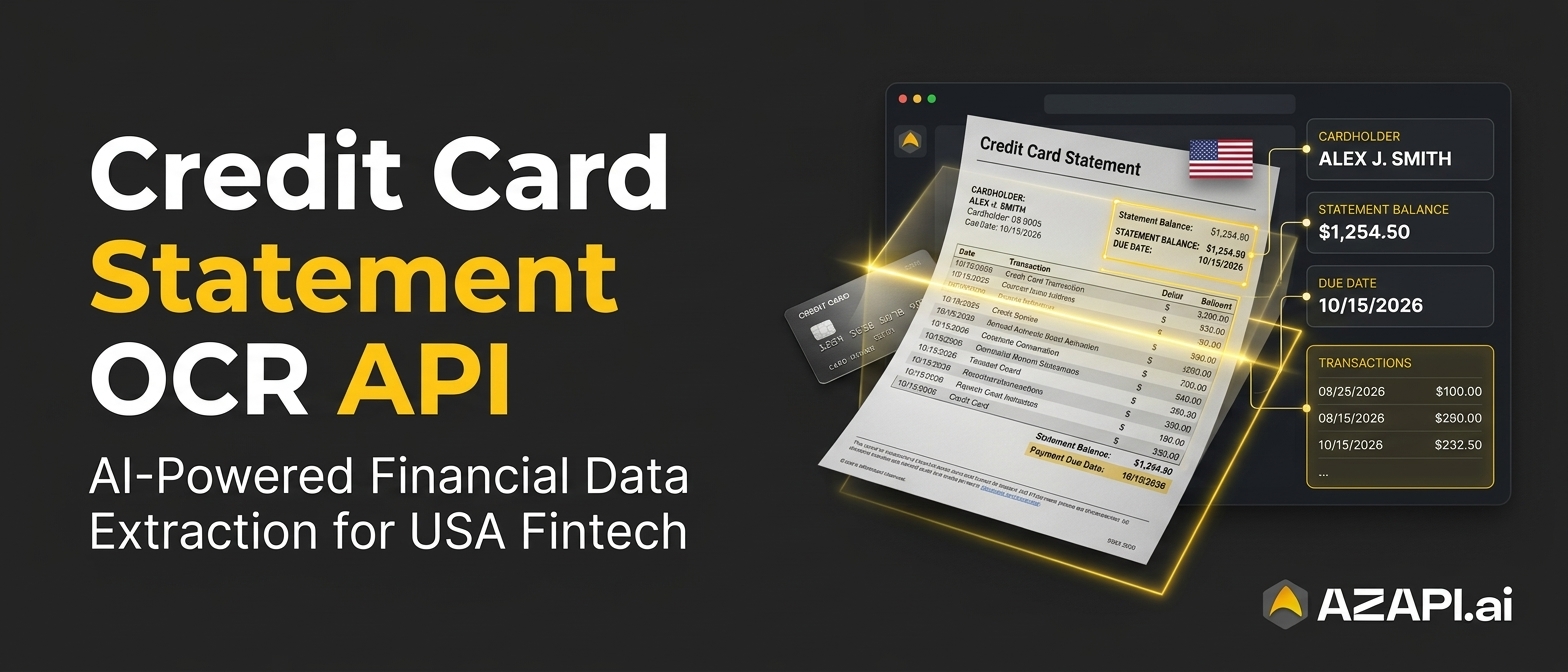
Credit Card Statements OCR API for USA: A Developer’s Guide to Financial Data Extraction
Explore how a Credit Card Statements OCR API for USA extracts transaction and billing data into structured digital records.

AZAPI SERVICES
Credit Card Statements OCR API for USA: A Developer’s Guide to Financial Data Extraction
Credit card statements are among the most frequently processed financial documents in fintech, lending, accounting, and expense management applications. They contain information such as account details, billing periods, transaction records, payment amounts, balances, and due dates. Although this information is useful for financial workflows, extracting it consistently from different statement formats can create technical challenges.
For developers, the challenge goes beyond converting document images into text. A financial application needs organized information that can be interpreted, stored, searched, and processed by other components. Transaction descriptions must remain associated with their dates and amounts. Billing information must be distinguished from transaction data. Missing fields must not be mistaken for incorrect values.
A Credit Card Statements OCR API for USA can help address these requirements by recognizing text in credit card statements and supporting the conversion of available document information into structured digital data.
This guide explores how credit card statement OCR works, which fields developers may need to extract, common document-processing challenges, and important considerations when integrating an OCR API into a financial application.
1. Understanding Credit Card Statement Data
A credit card statement is a periodic financial document that summarizes account activity over a particular billing period. Depending on the issuing institution and statement format, it may contain several sections.
These sections can include:
Cardholder and account information
Statement date and billing period
Previous and current balances
Transaction dates and descriptions
Purchases, credits, and payment entries
Minimum payment information
Payment due date
Credit limit and available credit, where present
Interest and fee information, where available
The structure and terminology used in these documents can differ. One statement might display a billing cycle as a date range, while another may show separate opening and closing dates. Transaction descriptions may also contain merchant names, reference information, or additional text.
This variation makes it difficult to rely on simple text extraction alone.
For example, consider a statement containing the following transaction information:
Transaction Date Description Amount 05/12/2026 Online Purchase, $85.40 05/14/2026, Grocery Store $42.75 05/18/2026 Monthly Subscription $12.99
A financial application needs to preserve each transaction as an individual record. If the extracted information is combined incorrectly, the application may associate an amount with the wrong transaction or date.
This is why document recognition and structured data extraction should be considered together.
2. Why Manual Credit Card Statement Processing Creates Challenges
Many financial workflows still involve receiving statements as PDF documents, scanned pages, or image files. Employees or application users may need to review these documents and enter relevant information into another system.
This creates several practical difficulties.
Repetitive Data Entry
When businesses process multiple statements, manually entering account details, billing dates, transaction descriptions, and amounts can become repetitive.
The effort increases when the same information must be entered into multiple applications or databases.
Different Statement Layouts
Credit card statements do not always follow a common layout. Financial institutions may use different fonts, table structures, field labels, and page arrangements.
A solution designed around one fixed document template may struggle when presented with a different format.
Transaction Table Complexity
Transaction tables can contain many entries, and some statements may continue these tables across multiple pages.
An extraction workflow must preserve the relationship between transaction dates, descriptions, and amounts. It should also account for different date formats and negative or credit entries.
Scanned and Image-Based Documents
Some statements contain selectable digital text, while others are scanned documents or image-based PDFs.
In image-based documents, the text must first be recognized before an application can process the information.
Missing or Inconsistent Information
Not every statement contains the same fields. Some information may be unavailable, displayed in a different section, or presented using different terminology.
Applications must be designed to handle these situations without automatically treating missing information as an actual financial value.
3. How a Credit Card Statements OCR API Works
Optical Character Recognition (OCR) is a technology that identifies text in images and document files and converts it into machine-readable content.
A Credit Card Statements OCR API makes this capability accessible to applications through an API-based integration.
A typical document-processing workflow can be divided into several stages.
Step 1: Document Submission
The application receives a credit card statement from a user, business process, or document upload interface.
Depending on the API's supported input formats, the document may be submitted as a PDF or image file.
Before submission, developers should consider file size restrictions, supported formats, document quality, and secure handling of financial information.
Step 2: Text Recognition
The OCR process identifies visible text within the document.
This may include:
Account-related information
Transaction dates
Merchant or transaction descriptions
Monetary values
Billing period information
Payment details
Balance information
The recognition process converts document content into machine-readable text that can be used for subsequent extraction.
Step 3: Information Identification
Recognized text needs to be associated with meaningful fields.
For example, a date near the statement heading may represent the statement date, while dates inside a transaction table may represent individual transaction dates.
Similarly, an amount in a payment summary may have a different meaning from an amount in a transaction row.
Understanding the context of each field is important for producing useful structured information.
Step 4: Structured Data Extraction
The identified information can be organized into relevant data groups.
A financial application may require separate structures for:
Account information
Statement details
Transaction records
Payment information
Balance information
This organization allows applications to process individual fields rather than repeatedly searching through large blocks of extracted text.
Step 5: Application-Level Processing
After extraction, the receiving application can process the information according to its own business requirements.
For example, it may store transaction records, display statement summaries, or make extracted information available to an accounting or expense management workflow.
OCR extraction should not automatically be treated as financial verification. Applications should apply their own validation and review procedures where required.
4. Important Fields to Extract from US Credit Card Statements
The fields required by a financial application depend on its purpose. A lending platform may need different information from an expense management application.
However, several categories are commonly useful when working with US credit card statements.
Cardholder and Account Information
This section may include:
Cardholder name
Account or card number, where available
Billing address, where present
Account-related identifiers
Financial applications should handle sensitive account information carefully. Full account numbers should not be exposed unnecessarily in application interfaces or logs.
Statement and Billing Information
Statement-level information can help applications understand the reporting period.
Relevant fields may include:
Statement date
Billing cycle start date
Billing cycle end date
Previous balance
New balance
Payment due date
The billing period is particularly important when applications organize financial records by statement cycle rather than by document upload date.
Transaction Information
Transaction details are often one of the most important components of credit card statement extraction.
Depending on the document, useful fields can include:
Transaction date
Posting date, where available
Merchant or transaction description
Transaction amount
Credit or debit indication
Additional transaction reference information, where present
Applications should preserve each transaction as a separate record.
Payment and Balance Information
A statement may also contain information related to payments and balances, including:
Minimum payment due
Payment due date
Previous balance
Current statement balance
Payments and credits
Available credit, where present
The meaning of these fields should be preserved during extraction. For example, a minimum payment amount should not be confused with the total statement balance.
5. Technical Challenges Developers Should Consider
Integrating OCR into a financial application requires attention to more than text recognition. The quality of the resulting data also depends on how the application handles different document conditions.
Different Date Formats
Dates may appear in formats such as MM/DD/YYYY or other variations.
For US-focused applications, developers should define how dates are interpreted and stored. A consistent internal date format can make filtering, sorting, and reporting easier.
However, the original document value should also be retained where appropriate, particularly when a date is ambiguous.
Currency and Number Formatting
Financial documents may contain currency symbols, commas, decimal points, and negative amounts.
For example:
$1,250.00
$85.40
-$42.75
An application should preserve the meaning of the original amount and avoid accidentally removing decimal separators or changing the sign of a value.
Multi-Page Statements
A credit card statement may contain several pages. Transaction tables can continue from one page to another, while account summaries may appear only on the first page.
Developers should consider whether extracted records are complete across all pages and whether duplicate entries can occur during processing.
Similar-Looking Financial Values
A statement may display several monetary values close to one another, including the previous balance, new balance, minimum payment, and transaction amounts.
A simple text search may identify a number but fail to identify its correct meaning.
The extraction workflow should preserve the context and category of each value.
Low-Quality Scans
Blurry images, low resolution, skewed pages, shadows, and compression can affect OCR recognition.
Document quality checks and exception handling can help applications identify files that may require another upload or manual review.
Missing Fields
Applications should not assume that every credit card statement contains every possible field.
A missing available-credit value, for example, should remain unavailable rather than being represented as zero.
This distinction is important for accurate downstream processing.
6. Designing a Structured Data Model for Statement Extraction
One of the most important decisions in a document-processing application is how extracted information will be represented.
Keeping all recognized text in a single field may be sufficient for basic text search, but it is less useful when an application needs to display transactions, filter records, or generate reports.
A structured data model can separate the document into logical sections.
For example, a developer might organize the extracted information into the following conceptual groups:
Statement information
Statement date
Billing period
Previous balance
Current balance
Payment due date
Account information
Cardholder name
Account identifier
Billing address, where available
Transaction records
Transaction date
Posting date, where available
Description
Amount
An illustrative internal representation could look like this:
{
  "statement": {
    "statement_date": "2026-05-31",
    "billing_period": {
      "start_date": "2026-05-01",
      "end_date": "2026-05-31"
    },
    "current_balance": 1250.00,
    "payment_due_date": "2026-06-24"
  },
  "transactions": [
    {
      "transaction_date": "2026-05-12",
      "description": "Online Purchase",
      "amount": 85.40
    },
    {
      "transaction_date": "2026-05-14",
      "description": "Grocery Store",
      "amount": 42.75
    }
  ]
}
This is an illustrative application-level data structure, not a representation of AZAPI's actual API response schema.
The advantage of this approach is that each part of the statement can be handled independently. Transaction records can be stored in a separate database table, while statement-level information can be associated with the corresponding account and billing period.
Developers should also consider retaining the original document reference and extraction metadata for traceability.
7. API Integration Considerations
An API-based OCR solution can be incorporated into an existing application without requiring developers to build every document-recognition component themselves.
Before selecting and integrating a Credit Card Statements OCR API for USA, developers should evaluate several aspects.
Input Format Support
Check which document formats and file sizes the API accepts.
This is important because users may upload statements from different sources, including downloaded PDFs and scanned images.
Output Structure
Review how extracted information is returned.
Structured output can make it easier to map recognized fields into application models and databases.
Developers should understand how the API represents unavailable fields, multiple transactions, and document-level information.
Error Handling
An integration should account for unsuccessful document submissions, unsupported files, incomplete processing, and unexpected responses.
Clear error handling makes it easier to identify whether a problem occurred during file submission, OCR processing, or application-level data handling.
Security and Privacy
Credit card statements contain sensitive financial and personal information.
Developers should review the API provider's security documentation, data handling practices, retention policies, access controls, and applicable compliance requirements before processing real customer documents.
Applications should also avoid storing unnecessary sensitive information and should restrict access to financial records.
Integration Documentation
Clear API documentation helps developers understand authentication, request formats, supported files, response structures, and error conditions.
These details should be reviewed before implementation rather than assumed.
8. Where Credit Card Statements OCR Can Be Used
Structured extraction of credit card statement information can support different types of financial applications.
Fintech Applications
Fintech platforms may process financial documents as part of digital application and account-management workflows.
OCR-based extraction can help organize available statement information for further application processing.
Lending Platforms
Lending applications may collect credit card statements as supporting financial documents.
Extracted information can help organize statement details for review. Any financial assessment or lending decision requires separate business rules and appropriate verification processes.
Accounting Software
Accounting platforms may need transaction dates, descriptions, amounts, and statement periods to organize financial records.
Structured extraction can reduce the need to manually re-enter information from document files.
Expense Management Systems
Expense management applications can use transaction information to support expense-related workflows.
Extracted transaction records may be organized for further categorization, review, or reporting.
Financial Service Providers
Businesses working with financial documents may use OCR to digitize statement information and connect document-processing workflows with their existing applications.
The usefulness of extraction depends on the document fields available and the requirements of the receiving system.
9. How to Evaluate a Credit Card Statements OCR API
Choosing an OCR API should involve evaluating its suitability for the documents and workflows an application needs to support.
Here are some practical evaluation points.
Document compatibility: Check whether the API supports the file formats and document types used by your application.
Field coverage: Identify which statement fields can be extracted and whether the fields required by your workflow are available.
Transaction handling: Test whether multiple transaction records remain separately organized.
Layout variation: Evaluate documents with different layouts rather than testing only one statement format.
Output consistency: Review whether the output can be mapped into your application's data model.
Exception handling: Understand how incomplete, unclear, or unsupported documents are represented.
Security practices: Review how uploaded documents and extracted financial information are handled.
Integration requirements: Check authentication, request formats, response handling, documentation, and any usage restrictions.
Testing with representative documents is important. A solution should be evaluated against the actual statement formats and data requirements of the intended application.
10. Exploring AZAPI Credit Card Statements OCR API for USA
AZAPI provides a Credit Card Statements OCR API designed to help businesses extract available information from credit card statements and convert recognized document content into structured digital data.
The solution is relevant to fintech companies, lenders, financial service providers, accounting platforms, expense management applications, and developers working with financial documents.
The API focuses on OCR-based statement information extraction, including available transaction details, account information, statement periods, balances, and payment due dates.
For developers, this provides an opportunity to explore an API-based approach to financial document digitization and integrate statement extraction capabilities into existing application workflows.
11. Frequently Asked Questions
What is a Credit Card Statements OCR API for USA?
A Credit Card Statements OCR API for USA is an application programming interface that uses Optical Character Recognition to identify text in credit card statement documents and support the extraction of available information into digital data.
What information can be extracted from a credit card statement?
Depending on the statement format, available information may include cardholder details, account information, transaction dates, descriptions, amounts, statement periods, balances, and payment due dates.
Can OCR extract individual credit card transactions?
OCR-based document extraction can recognize transaction information such as dates, descriptions, and amounts. Applications should ensure that each extracted transaction remains associated with its corresponding fields.
Why do different credit card statement formats create extraction challenges?
Financial institutions may use different layouts, labels, fonts, and transaction table structures. These differences can affect how document information is recognized and organized.
Is OCR output automatically verified financial information?
No. OCR identifies and extracts information from documents. It does not independently establish that the financial information is accurate or authentic. Applications may require additional validation and review.
Who can use a credit card statement OCR solution?
Fintech companies, lenders, accounting software providers, expense management platforms, financial service providers, and developers working with financial documents may find statement OCR useful.
How can developers integrate statement OCR into an application?
Developers can connect an OCR API to their application, submit supported statement documents, receive extracted information, and map the available data into their own application models and workflows. The exact implementation depends on the API's documentation and supported integration methods.
Conclusion
Credit card statement processing involves multiple types of financial information, from account details and billing periods to individual transaction records. Extracting this information consistently requires attention to document layouts, date and amount formats, missing fields, and transaction relationships.
A Credit Card Statements OCR API for USA can help developers convert available statement information into structured digital data and reduce repetitive manual data entry.
For businesses building fintech, accounting, lending, and expense management applications, OCR-based extraction offers an approach to organizing financial documents and connecting document information with existing software workflows.
Explore AZAPI Credit Card Statements OCR API to learn more about financial document data extraction and API integration.
About the Author
AZAPI SERVICES
AZAPI.ai offers AI-powered APIs for OCR, document extraction, CAPTCHA solving, IMEI verification, and mobile warranty checks, helping businesses automate workflows and simplify data processing.