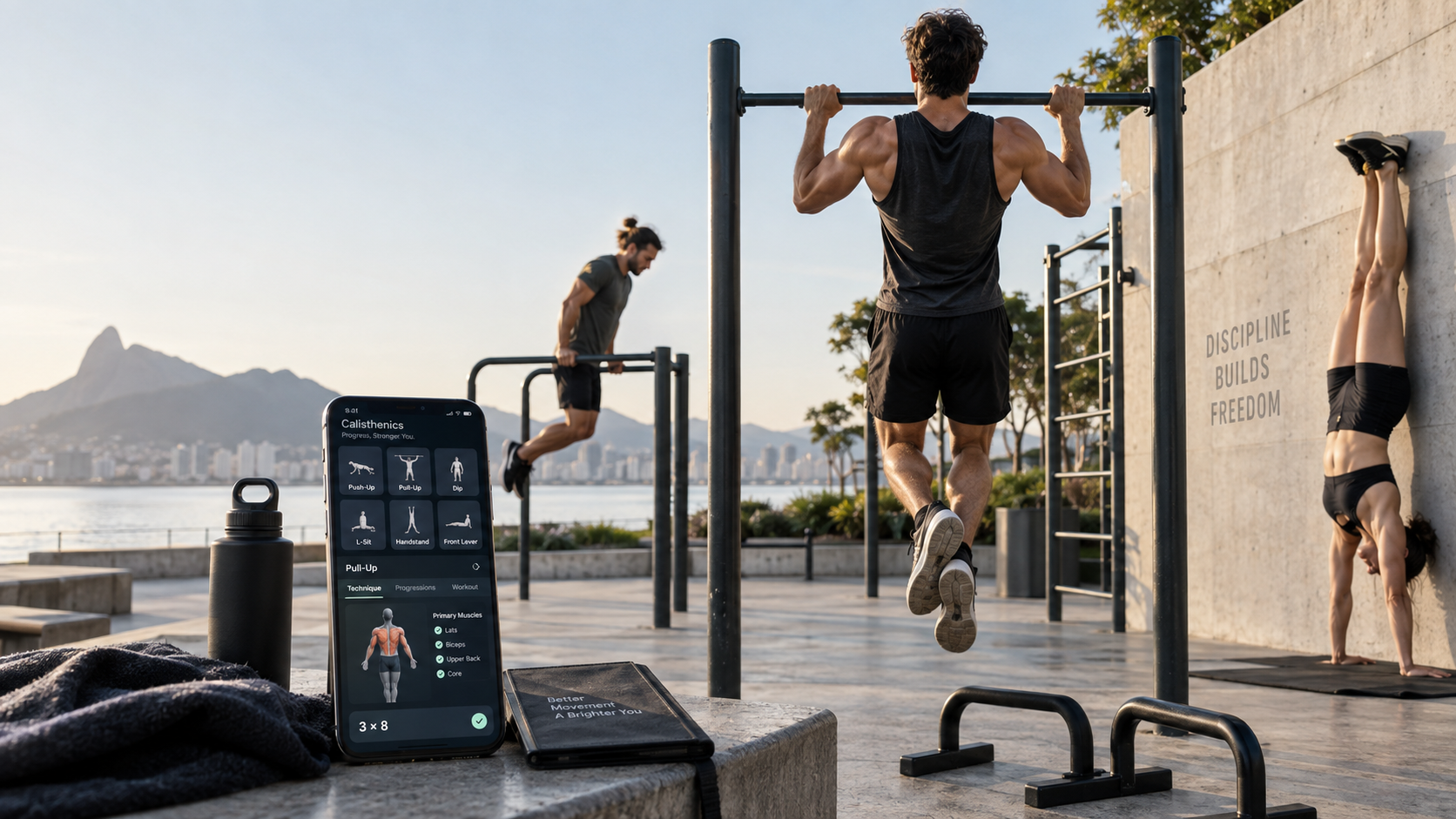
Calisthenics Exercises: Build Strength, Mobility, and Body Control
Calisthenics Exercises provide a flexible way to develop strength, mobility, coordination, and body control using primarily bodyweight movements.
Cindy Larose
Calisthenics Exercises are movements that primarily use body weight as resistance. They can help develop strength, coordination, mobility, balance, and overall movement skills without requiring complicated gym equipment.
Because many exercises can be adjusted to different ability levels, calisthenics can be suitable for beginners as well as people with more training experience. The most important approach is to learn movements gradually, use good technique, and allow enough recovery between sessions.
What Are Calisthenics Exercises?
Calisthenics Exercises use the body's own weight to create resistance.
Common movements include squats, push-ups, lunges, planks, rows, and supported hanging exercises.
Instead of increasing weight on a machine, progression can come from improving technique, increasing repetitions gradually, changing leverage, or moving to a slightly more challenging variation.
This makes calisthenics flexible and accessible.
Benefits of Calisthenics Training
Calisthenics can train several physical qualities at the same time.
Exercises may improve muscular strength, coordination, stability, and movement control.
Many movements also involve several muscle groups together rather than isolating one area.
For example, a push-up involves the upper body while also requiring the core and lower body to remain stable.
This can make training practical and efficient.
Start with Basic Movements
Beginners do not need advanced exercises.
Starting with fundamental movements provides a better foundation.
Useful beginner patterns include:
Squatting
Pushing
Pulling or rowing
Lunging
Core stability
Controlled hanging where appropriate
Mastering easier versions first can make future progress safer and more consistent.
Bodyweight Squats
Bodyweight squats train the legs while developing balance and movement control.
Begin from a comfortable standing position and lower only as far as you can while maintaining a controlled posture.
The goal is not to force maximum depth.
A comfortable range of motion is more important than copying someone else's squat.
As control improves, the movement can gradually become smoother and more confident.
Push-Ups
Push-ups are a common upper-body calisthenics exercise.
They involve the chest, shoulders, arms, and core.
Beginners who find floor push-ups difficult can start with their hands placed on a stable elevated surface.
This reduces the resistance while allowing the same general movement pattern to be practiced.
Progress should come gradually rather than by sacrificing form.
Lunges
Lunges help train each leg more independently.
They can also challenge balance and coordination.
Beginners may begin with stationary split-stance movements before trying more dynamic variations.
Using a stable object for light support can be helpful when learning.
Controlled movement is more important than taking a very large step.
Glute Bridges
Glute bridges are a simple floor exercise that can develop hip strength and control.
The movement involves lifting the hips from the floor while keeping the motion comfortable and controlled.
It can be useful as part of a beginner routine because it does not require equipment and can complement squats and lunges.
Avoid forcing the lower back into an exaggerated position.
Planks
Planks are used to train core stability.
The objective is to maintain a controlled body position rather than simply holding the exercise for the longest possible time.
Beginners can use shorter holds and focus on maintaining good form.
If technique starts to break down, ending the set is usually more useful than continuing just to increase the time.
Side Planks
Side planks provide a different core challenge.
They require the body to resist bending sideways while maintaining balance.
Easier versions can be performed with additional support.
Like regular planks, quality matters more than extremely long holds.
Gradual progression allows the supporting muscles to adapt.
Bodyweight Rows
Rows help develop the muscles involved in pulling.
They require suitable stable equipment, so the setup should always be secure before use.
Beginners can often adjust the difficulty by changing body position.
Pulling exercises can help balance routines that include a lot of push-ups.
When safe equipment is unavailable, another appropriate pulling exercise supervised by a knowledgeable coach may be preferable.
Hanging Exercises
Hanging can develop grip and introduce the body to overhead positions.
However, it requires a properly secured bar and comfortable shoulder movement.
Beginners should not rush into difficult hanging skills.
Simple supported practice may be enough at first.
Anyone who experiences pain should stop rather than trying to push through it.
Calisthenics for Beginners
A beginner program does not need many exercises.
A small number of basic movements practiced consistently can provide plenty of learning.
For example, a session might include an appropriate squat variation, an easier push-up variation, a safe pulling exercise, a hip movement, and a simple core exercise.
Beginners should leave enough time for recovery and avoid trying to progress every movement at once.
Focus on Technique
Technique is especially important in bodyweight training.
Performing more repetitions is not useful if movement quality becomes poor.
Use controlled repetitions and a comfortable range of motion.
If an exercise feels too difficult to perform smoothly, choose an easier variation.
Building strong movement habits early can make later progression easier.
Progress Gradually
Calisthenics can become harder without adding traditional weights.
A movement may be progressed by increasing control, using a larger comfortable range of motion, adding a few repetitions, or choosing a slightly more challenging variation.
Only one change may be needed at a time.
Progress does not need to happen every workout.
Consistency over weeks and months is more useful than rushing toward advanced variations.
Include Pulling and Pushing
Balanced training should not focus only on one movement pattern.
People often practice many push-ups because they are easy to perform almost anywhere.
Pulling exercises deserve attention as well.
A balanced routine can include pushing, pulling, lower-body movements, and core work.
This creates a more complete training approach.
Train the Lower Body
Calisthenics is sometimes associated mainly with upper-body exercises, but lower-body training is equally important.
Squats, lunges, bridges, step-based movements, and other appropriate exercises can develop leg strength and coordination.
Training the whole body provides a stronger foundation than focusing only on visually impressive skills.
Mobility and Warm-Up
A warm-up can help prepare the body for movement.
Simple dynamic movements related to the upcoming exercises are often enough.
There is no need to make the warm-up exhausting.
Mobility work can also be included according to individual needs.
Comfortable, controlled movement should remain the priority.
Recovery Matters
Muscles and joints need time to recover after training.
Doing intense calisthenics every day is not necessary for progress.
Rest days or easier activity can be included between harder sessions.
Sleep, regular meals, and normal daily hydration also support recovery.
Training should fit into a healthy routine rather than take over it.
Avoid Comparing Progress
People progress at different speeds.
Someone else may perform a more advanced exercise because they have trained longer or have a different background.
Comparing yourself constantly with others can encourage poor decisions.
A better approach is to compare your current control and consistency with your own previous training.
Personal progress is what matters.
Advanced Skills Take Time
Calisthenics includes advanced movements that can require substantial strength, technique, balance, and practice.
They should not be treated as beginner exercises.
Build fundamental strength first and learn challenging skills progressively with appropriate supervision when needed.
Skipping foundational work can make training unnecessarily difficult.
Listen to Pain Signals
Exercise can feel challenging, but sharp or unusual pain should not be ignored.
Stop an exercise if it causes pain rather than attempting to push through it.
If pain continues or movement remains uncomfortable, tell a parent, guardian, coach, or another trusted adult and seek appropriate professional advice.
Training should support health rather than create unnecessary risk.
Make Training Consistent
Consistency matters more than complicated routines.
A simple program performed regularly can be more useful than constantly changing exercises.
Keep track of the variations you perform and how they feel.
When an exercise becomes comfortable with good technique, consider a gradual progression.
This creates a steady learning process.
Calisthenics at Home
Many basic Calisthenics Exercises can be performed at home with open floor space.
Exercises such as squats, lunges, bridges, planks, and appropriate push-up variations need little equipment.
Any exercise involving bars, furniture, or elevated surfaces requires extra attention to stability.
Do not use objects that could move, break, or tip over during exercise.
Build a Balanced Routine
A balanced calisthenics routine can include movements for the upper body, lower body, and core.
It should also include enough recovery.
There is no need to complete a huge number of exercises in one session.
Choose a manageable selection and practice them well.
A simple routine is easier to maintain and improve over time.
Conclusion
Calisthenics Exercises provide a flexible way to develop strength, mobility, coordination, and body control using primarily bodyweight movements.
Exercises such as squats, push-ups, lunges, bridges, planks, and suitable pulling movements can create a strong foundation when practiced with good technique.
The key is gradual progression rather than rushing toward difficult skills.
Use appropriate exercise variations, prioritize controlled movement, include recovery, and stop if something causes pain.
With consistent and sensible practice, calisthenics can become an enjoyable way to build useful movement skills and general fitness.
About the Author
Cindy Larose
No bio available