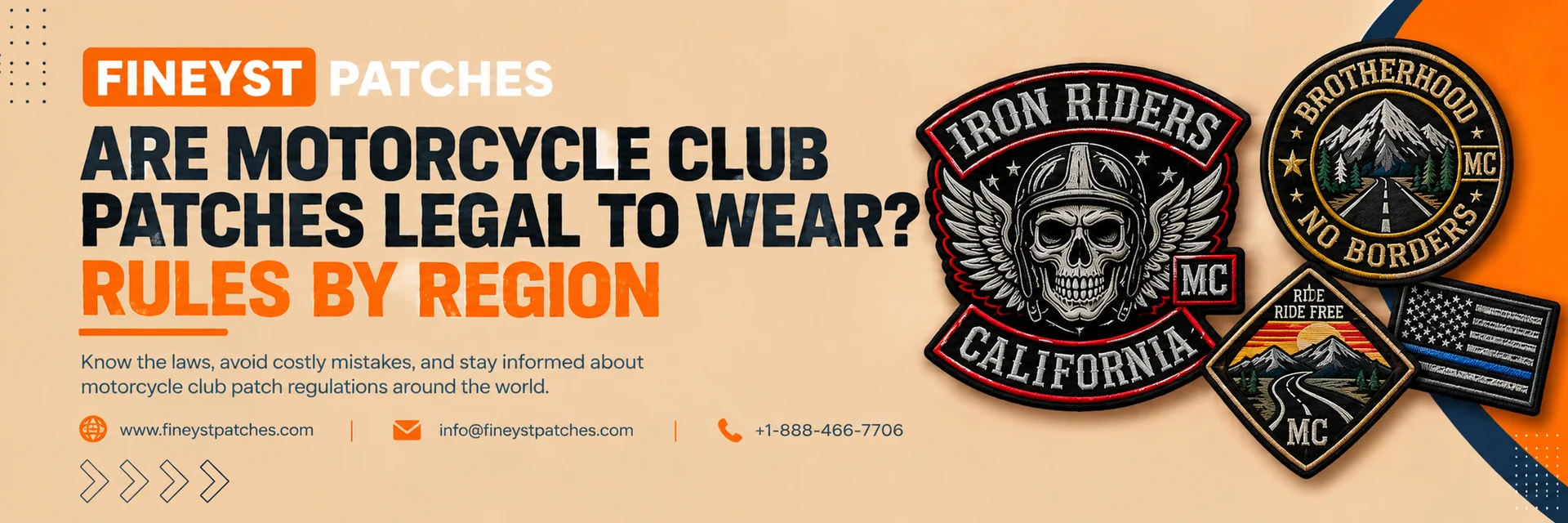
Are Motorcycle Club Patches Legal to Wear? Rules by Region
Are motorcycle club patches legal to wear? Learn about club colors, 1% patches, custom designs, trademark concerns, and local laws.
Fineyst Patches
Are motorcycle club patches legal to wear? In many places, yes—but the answer depends on your location, the type of patch, and how you use it. Wearing a motorcycle-themed patch is generally different from wearing the official colors of a specific motorcycle club, copying a protected club logo, or displaying insignia restricted by local law.
Motorcycle patches often represent identity, brotherhood, riding experience, and club membership. Some are simple decorative designs, while others identify a rider's club, chapter, rank, or affiliation. Understanding these differences can help you choose patches that reflect your personality without creating avoidable legal or social problems.
Are Motorcycle Club Patches Legal to Wear?
In many jurisdictions, wearing motorcycle club-style patches is not automatically illegal. However, there is no single worldwide rule that applies to every patch or motorcycle club.
The legal position may depend on several factors:
Your location: National, state, provincial, and local laws may differ.
The design: Generic motorcycle graphics are different from insignia associated with a particular organization.
The purpose: Wearing a patch as personal expression is different from using it to falsely claim membership or official authority.
The setting: A private business, motorcycle event, workplace, or other venue may have its own dress code.
The organization represented: Certain club insignia may be protected by intellectual property laws or subject to specific legal restrictions.
For example, the United States Patent and Trademark Office recognizes collective membership marks as symbols that can identify membership in an organization, including motorcycle clubs. This illustrates why some patches have a specific organizational meaning rather than serving as ordinary decoration.
The safest approach is to check the laws that apply where you plan to wear the patch and determine whether the design represents a real organization.
1. Are Motorcycle Club Patches Illegal in the United States?
In the United States, wearing a motorcycle-themed patch is not generally prohibited simply because it resembles biker clothing. However, the exact design and circumstances can matter.
A patch displaying a motorcycle, an eagle, a skull, a flag, or a personal slogan is different from one that reproduces a specific club's insignia or falsely implies membership.
Important Legal Considerations
Trademark and membership symbols: Some motorcycle clubs use distinctive names and logos to identify their organizations. Unauthorized commercial use of protected marks, particularly where it creates confusion about affiliation or endorsement, may raise legal issues.
Misrepresentation: Claiming to be an authorized club member, representative, police officer, or military official when you are not may create legal problems depending on the circumstances and applicable law.
Freedom of expression: Wearing a patch can communicate identity or beliefs, but that does not mean every use of every symbol is automatically protected in every situation. The legal outcome depends on the facts and applicable law.
A court dispute involving the Mongols Motorcycle Club illustrates that government restrictions on club insignia can raise complex trademark and constitutional questions. The details of a particular case should not be treated as a universal rule for every motorcycle patch.
2. Are Three-Piece Motorcycle Club Patches Legal?
Three-piece motorcycle back patches typically feature a top rocker, a central emblem, and a bottom rocker. The top rocker often displays the club's name, the central piece contains its emblem, and the bottom rocker may identify a city, state, province, or region.
This arrangement is associated with some traditional motorcycle clubs, but the format alone does not establish that a patch is illegal.
The main considerations are whether the design copies an existing club's insignia, implies an affiliation that does not exist, or falls under a specific local restriction.
Why Three-Piece Patches Can Be Sensitive
They may resemble the official colors of an established motorcycle club.
A geographic bottom rocker can suggest a connection to a particular chapter or territory.
A recognizable central emblem may be associated with a specific organization.
Some clubs have strict rules about who may display their colors.
If you are designing a vest for a new riding group, consider creating an original emblem and clearly identifying your group. Avoid copying an established club's name, logo, or distinctive layout in a way that could cause confusion.
3. Can You Wear a Motorcycle Club Patch Without Being a Member?
In some places, wearing a patch is legally permissible even if you do not belong to the organization it resembles. However, that does not mean every club patch is appropriate to wear without permission.
Many motorcycle clubs treat their official colors as symbols of membership. They may restrict the use of their logos, names, chapter identifiers, and rank patches to authorized members.
Wearing those symbols without permission can cause confusion or unwanted confrontation, even when the act itself is not prohibited by law.
Patches to Consider Carefully
Official club logos: These may identify membership in a specific organization.
Chapter or location rockers: These can imply affiliation with a particular chapter or region.
Rank patches: Titles such as President, Vice President, or Sergeant at Arms may indicate a role within a club.
Support patches: Some designs are used to show a recognized relationship with a particular club.
Membership-specific symbols: Certain emblems are intended only for authorized members.
If your goal is simply to decorate a motorcycle vest, generic riding patches or original artwork are usually a more straightforward choice than reproducing a real club's identity.
4. Are “1%” Motorcycle Patches Legal?
The “1%” diamond is associated with some outlaw motorcycle club culture. Its meaning can vary with context, and it is not simply a generic symbol for every motorcycle enthusiast.
The legality of displaying a “1%” patch depends on the jurisdiction and circumstances. The symbol alone should not automatically be assumed to be illegal, but wearing it may communicate an affiliation or identity you did not intend to claim.
Before using this patch, consider its cultural meaning, whether it is connected to a particular organization, and whether local laws impose restrictions on insignia associated with designated groups.
If you are not intentionally representing that culture, a different design may communicate your interest in motorcycles more clearly.
5. Can You Wear Another Motorcycle Club's Colors?
Whether you can legally wear another club's colors and whether you should do so are two different questions.
A club's colors may consist of its name, central emblem, chapter rocker, and other identifying patches. In many motorcycle communities, these are treated as symbols of membership and are not meant to be worn casually by outsiders.
Wearing another club's insignia without authorization may lead to misunderstandings or conflict. It may also raise intellectual property or misrepresentation issues depending on the design and how it is used.
How to Avoid Problems
Do not copy a real club's full back-patch design without permission.
Avoid wearing rank or membership patches that falsely suggest you hold a position.
Research the meaning of unfamiliar motorcycle symbols before using them.
If you want to support a club, check whether it offers authorized merchandise or support patches.
When uncertain, choose a neutral design or ask the organization about its policies.
Respecting club identity can help prevent misunderstandings while allowing you to express your own riding interests.
6. Can Motorcycle Club Patches Be Banned by Law?
Yes, specific insignia can be restricted in some jurisdictions, but such restrictions are not universal.
Some places have enacted laws addressing the public display of symbols associated with legally designated organizations. Other places rely primarily on general laws covering issues such as impersonation, fraud, or unauthorized use of protected marks.
This distinction matters: a rule adopted by a motorcycle club is not automatically a government law, and a venue's dress code is not the same as a criminal prohibition.
What to Check in Your Area
Before wearing a potentially sensitive patch, investigate:
Whether your jurisdiction restricts the display of insignia associated with designated organizations.
Whether the patch reproduces a protected trademark or falsely suggests affiliation.
Whether the venue or event has a policy on motorcycle club colors.
Whether a local law applies to possession, public display, sale, or manufacture of the insignia.
Because laws can change and differ between jurisdictions, verify the current rules rather than relying on advice intended for another country or state.
7. Can Bars, Events, and Private Businesses Ban Motorcycle Patches?
A patch may be legal to wear in public but still be prohibited by a private venue's dress code.
Bars, restaurants, clubs, private events, and other businesses may restrict certain clothing or symbols, subject to applicable law. A venue may have a policy against motorcycle club colors, large back patches, or particular insignia.
Such a policy does not necessarily mean the patch itself is illegal. It may simply mean the venue does not permit that clothing on its premises.
If you are attending a motorcycle rally, concert, bar, or organized ride, check the event's clothing rules beforehand. If staff ask you to cover or remove a patch, clarify the policy calmly and decide whether to comply or leave.
8. Are Custom Motorcycle Patches Legal to Make and Sell?
Custom motorcycle patches are often used by independent riders, riding groups, businesses, and motorcycle enthusiasts. Creating an original design is generally a simpler option than reproducing a real club's protected identity.
However, manufacturing and selling patches can involve additional legal considerations.
Guidelines for Custom Patch Designs
Create original artwork: Develop your own name, emblem, typography, and visual identity instead of copying an existing club's logo.
Avoid misleading claims: Do not market a patch as official club merchandise or authorized insignia unless you have permission.
Check trademarks: Search for existing names and logos before producing designs for commercial sale.
Use official insignia with permission: If a club commissions a patch or authorizes you to reproduce its colors, clarify the permitted use and obtain appropriate approval.
Understand local rules: If the patch depicts a symbol restricted by law in your jurisdiction, ordinary customization does not necessarily make it lawful.
These precautions can help reduce disputes and protect both the designer and the organization whose identity may be represented.
9. What Motorcycle Patches Are Usually Lower-Risk Choices?
If you want to personalize a jacket or vest without implying membership in a particular club, consider designs that clearly express your own interests.
Examples include:
Motorcycle brands or models you own or admire, used in accordance with applicable trademark rules.
Generic motorcycle graphics and riding illustrations.
National or regional flags, where their use is lawful.
Personal names, nicknames, or original artwork.
Touring and rally patches obtained from events you attended.
Original logos for your own riding group.
General messages about riding, travel, or motorcycle safety.
No category is guaranteed to be lawful in every circumstance, but original designs that do not falsely imply affiliation are often easier to assess than copied club colors.
10. What Should You Do Before Wearing a Motorcycle Club Patch?
A little research can help you avoid unnecessary legal uncertainty and social misunderstandings.
Step 1: Identify the Design
Determine whether the patch is generic artwork, an original design, an official club emblem, or a symbol with a specific cultural meaning.
Step 2: Check Your Local Laws
Look for current rules in the country, state, province, or city where you intend to wear it. Do not assume that advice from another jurisdiction applies to you.
Step 3: Confirm Permission When Needed
If the patch represents a real club, ask the organization whether it permits non-members to display its insignia or purchase its official merchandise.
Step 4: Consider the Setting
A patch accepted at a general motorcycle rally may not be allowed at a particular business or private event.
Step 5: Choose an Alternative if Uncertain
If the design's meaning or legal status is unclear, use original artwork or a generic motorcycle patch until you can verify the details.
Frequently Asked Questions
Are motorcycle patches illegal for civilians?
Not automatically. In many jurisdictions, civilians can wear generic motorcycle patches. Specific insignia, misleading representations, and local restrictions may change the legal position.
Can I wear a motorcycle club patch if I am not a member?
That depends on the design and location. Even when wearing it is not illegal, displaying a real club's colors without authorization can imply membership and cause social problems.
Is it illegal to wear a “1%” patch?
Not universally. Its meaning and legal implications depend on the jurisdiction, context, and any applicable restrictions on specific insignia.
Can I make my own motorcycle club patch?
Creating an original patch for your own riding group is generally a more straightforward option. Avoid copying protected logos or falsely implying that your group is affiliated with an established organization.
Can a business refuse entry because of motorcycle patches?
A private venue may enforce a clothing policy, subject to applicable law. A restriction imposed by a business is different from a general legal ban on wearing the patch.
Do motorcycle club patch rules differ by country?
Yes. The laws governing insignia, trademarks, public display, and designated organizations vary by jurisdiction. Always check the current rules where you plan to wear the patch.
Final Thoughts
So, are motorcycle club patches legal to wear? In many places, yes—but the answer depends on the patch itself, the way it is used, and the laws that apply in your location.
Generic motorcycle graphics and original designs are different from official club colors, membership insignia, or symbols restricted by local legislation. Even when a patch is legally permissible, a motorcycle club or private venue may have its own rules about displaying it.
Before choosing a patch, understand its meaning, avoid implying membership you do not have, and verify any relevant local restrictions. When a particular club logo or legal issue is involved, seek permission from the organization or consult a qualified local lawyer.
The best patch is one that reflects your riding identity while respecting the law and the meaning that motorcycle communities attach to their insignia.
About the Author
Fineyst Patches
No bio available