A colleague's yes is not the last approval: reviewing shift swaps in Insacheck
A documentation review of employee requests, colleague acceptance and manager approval in Insacheck shift swaps, with a practical pilot checklist.

Work Notebook
Disclosure: prepared for Insacheck's external-information project with AI assistance. This is a review of the public scheduling documentation checked on 29 October 2026, not an independent customer testimonial or a test of a company's live employee accounts.
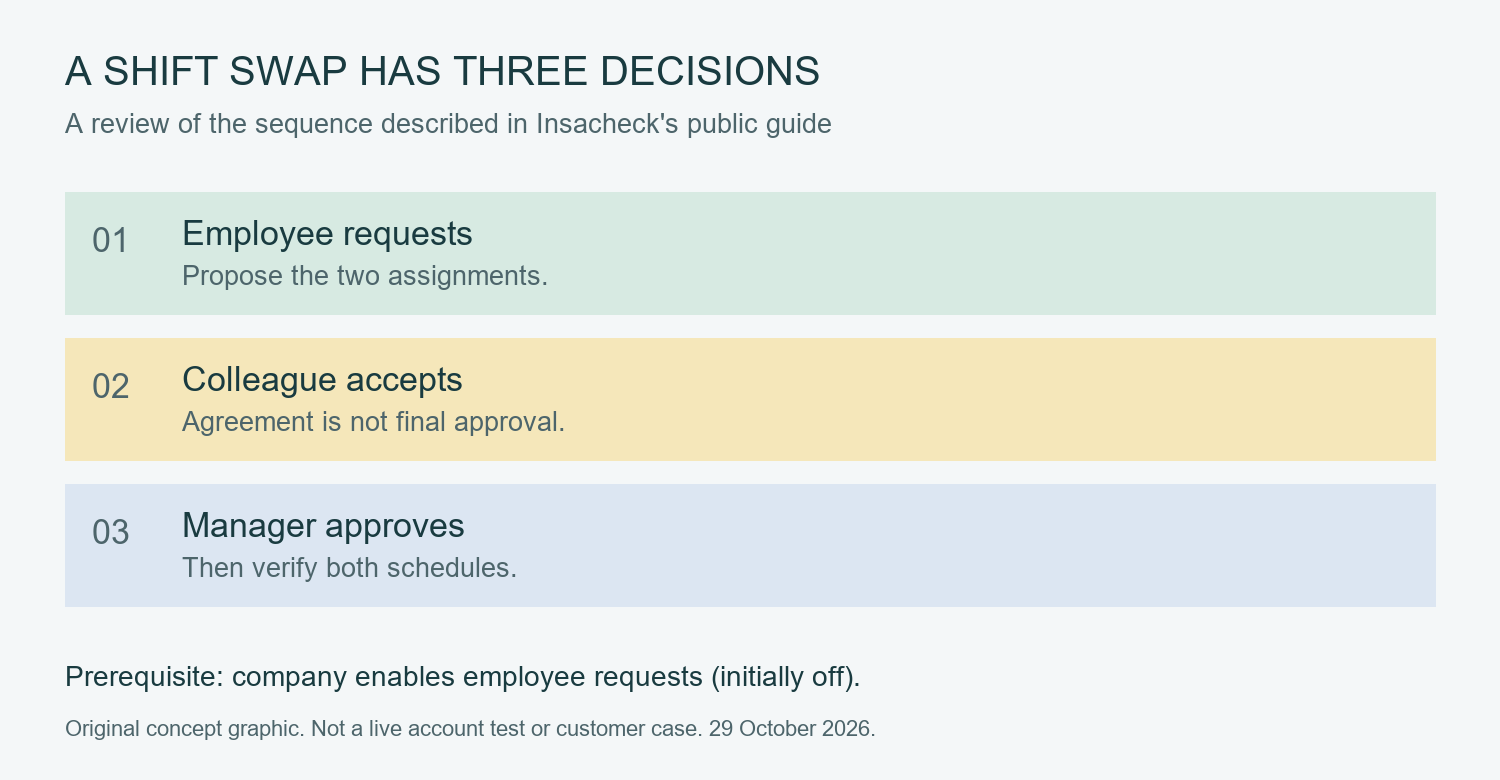
Original concept graphic based on the public guide. Not a product screenshot or a completed live-account test.
Two colleagues can agree to exchange shifts before the person responsible for the rota has approved the change. That gap is easy to lose in a message thread. A useful shift-swap workflow needs to show whose decision has happened, and whose decision is still missing.
Insacheck's public scheduling guide describes three steps: an employee requests a swap, the other employee accepts, and a manager approves. It also says that the company must enable employee requests; the option is off initially. Those two details are more useful for an implementation review than a broad promise that staff can manage every rota change themselves.
Start with the company setting
Before telling employees to use the feature, ask the company administrator to confirm that employee requests are enabled for the intended team. A missing request option is not automatically a failed submission or a colleague refusing to help. It may mean that the feature has not been enabled.
The public guide does not establish how every company's permissions are configured. The first pilot check should therefore be practical: can the intended employee see the request action, and can the intended manager see the decision that follows?
A colleague's acceptance is an intermediate decision
Consider a fictional climbing centre reception team. Laila is assigned Wednesday morning and Jon Friday afternoon. They would like to exchange those two assignments. This is an illustration of the approval sequence, not a report about an actual Insacheck customer.
Laila's request tells Jon what she is proposing. Jon's acceptance supplies his agreement. It does not, in the documented sequence, replace the manager's approval. Staff should not treat a friendly reply or an accepted request as the final rota simply because both people are willing.
- Request submitted: a proposed exchange has entered the process.
- Other employee accepts: the counterpart has agreed, but the manager's decision remains.
- Manager approves: the guide says the two assignments are exchanged at this point.
Verify the outcome in both schedules
A sensible pilot follows one exchange through to the end and then checks both employees' assigned dates and times. Keep a before-and-after note for that pilot. The aim is to verify the result in the actual tenant, rather than relying on two people remembering the same conversation.
This review did not submit a live request, accept one or approve one. It does not establish notification delivery, audit-log fields, expiry rules or cancellation behaviour. Ask the provider to demonstrate those details before making them part of an internal procedure.
A swap is not the same as finding cover
In the example, two existing assignments are exchanged. If Jon is not exchanging a shift and is simply covering an otherwise empty slot, that is a different scheduling question. Insacheck's guide describes urgent or substitute assignments separately. Do not use the swap label as a catch-all for every staffing change.
A day-off preference is different again. It informs the person building the rota; it is not evidence that a specific colleague accepted a swap or that a manager approved one. Keep the labels distinct in staff instructions.
Two useful exception checks before rollout
First, leave a sample request waiting for the counterpart and ask staff to identify the current responsible person. Then review a request after counterpart acceptance but before the manager's decision. Can everyone tell that the workflow is still unfinished? These are proposed pilot checks, not tests completed for this article.
Second, ask what happens if an original assignment changes while the request is open. Does the request remain actionable, require a new submission or show a conflict? The public summary does not answer that question, so a review should preserve it as an open item rather than invent automatic protection.
The source is Insacheck's shift scheduling guide, whose interface is in Korean. Its request-acceptance-approval sequence gives a useful review structure. Whether that structure works for a particular team still needs a controlled demonstration with that company's settings and permissions.
The practical takeaway is small: record which stage the swap has reached, then verify the final assignments. Agreement between colleagues is important, but it should not erase the separate manager decision described by the product.
About the Author
Work Notebook
Product-documentation reviews and practical workflow notes. Brand-project relationships and review limits are disclosed in each article.